I.
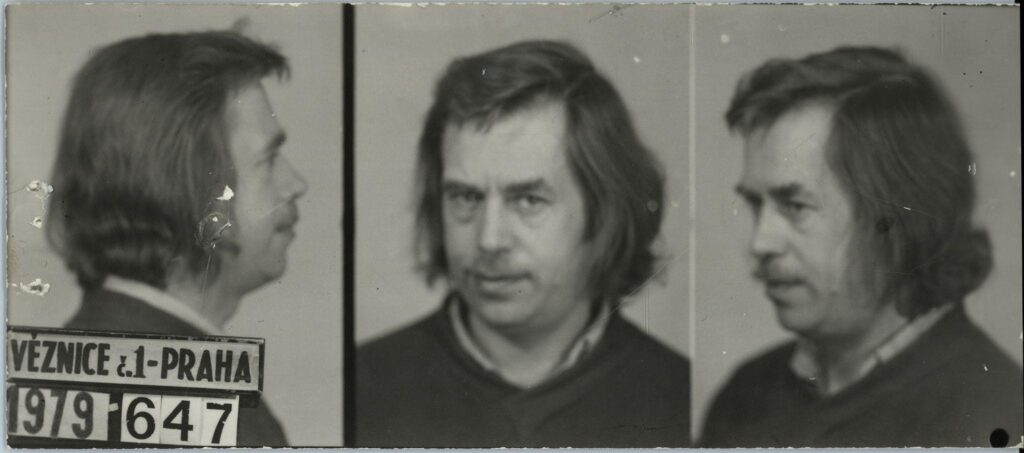
The top three places in “The Greatest Czech”, a poll held by Czech Television in 2005, went – far ahead of the rest of the field – to Charles IV, Holy Roman Emperor and King of Bohemia; to Tomáš Garrigue Masaryk, founder and first president of independent Czechoslovakia; and to Václav Havel, leader of the Velvet Revolution, last president of Czechoslovakia and first president of the Czech Republic. Like almost everything in Czech history, the choice seems at once self-evident and faintly absurd. While few would question the greatness and historical importance of any of the three, their Czechness is rather less self-evident. Charles’s mother Elizabeth was a Přemyslid, but his father was John of Luxembourg; the young prince was brought up at the French royal court and spoke no Czech until his return to Bohemia at the age of seventeen. TGM was Slovak on his father’s side, and his mother Terezie spoke better German than Czech. According to some conspiracy theories, Masaryk’s looks even betray Habsburg ancestry. Of the three greatest Czechs, then, it is Václav Havel whose Czech pedigree is the least open to dispute. Havel is Czech by descent, by first name and by surname – he even looks Czech.

photo ©ČTK, 1974
Yet even Havel has been criticised for a certain lukewarmness in his Czechness, for a lack of patriotism and a deracinated cosmopolitanism. His critics point to his notion of each person’s universal responsibility for the world around them, to his view of human rights as a global task, to his close ties with the wider horizon of European culture, including its transatlantic branch, and to his aversion to every form of xenophobia and intolerance between nations and cultures – home-grown nationalist chest-thumping included. Yet this openness to the world, and this sense of responsibility for it, spring from a deep conviction that both individual and Czech identity have meaning. In this respect Václav Havel was a conscious and committed follower of Masaryk’s maxim that “the Czech question is either a world question or it is no question at all”.
II.
The problem of identity, whether individual or collective, is central to Havel. His critique of modern civilisation is inseparable from the search for identity and its loss. In The Garden Party, the first of his plays to win international renown, Havel places a paraphrase of Hamlet’s famous soliloquy on whether to be or not to be in the mouth of his protagonist, Hugo Pludek – a figure knowingly borrowed from the fairy tale of Honza, the simple Czech country lad who is loath to leave his native village, but who, after all manner of adventures and obstacles overcome, wins both the kingdom and the princess through his earthy charm and peasant common sense:
Petr Borovec as Hugo Pludek in The Garden Party, East Bohemian Theatre, Pardubice
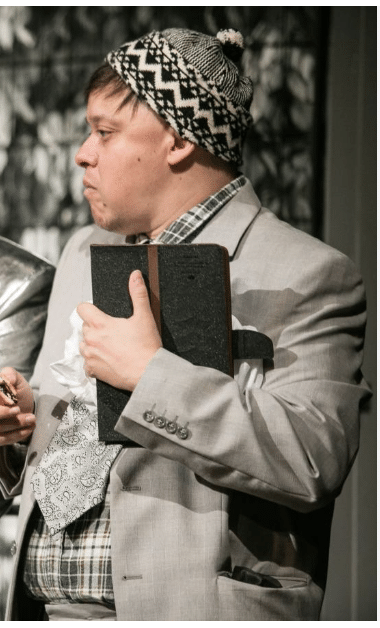
photo Jan Faukner
“We are all a little bit what we were yesterday and a little bit what we are today; and a little bit we aren’t even that; all of us are always a little bit being and always a little bit not being; some of us more are and some of us more aren’t; some of us only are, some of us are only, and some of us only aren’t; so that none of us entirely is, and at the same time each of us entirely isn’t, and the only question is when it is better to be more and not-be less, and when, on the contrary, it is better to be less and not-be more; besides, whoever is too much may soon not be at all, and whoever knows how, in a given situation, to not-be to a certain degree may all the better be in another. I don’t know whether you want more to be or more not to be, or when you want to be and when not to be, but I want to be all the time, and that is why I must always a little bit not be – because a man who now and then a little bit isn’t is none the less for it!”
Although Hugo is not an altogether attractive character and his monologue bears the hallmarks of absurdist satire, its import is deadly serious. Unlike in the past, when a person’s identity was firmly bound to origin, place, soil and social station, the identity of modern man is fluid and changeable. It moves between extremes, from amorphous absence to assertive proclamation. We do not find our identity as something given; we seek it and discover it through what we do.
III.
Havel applied his conception of identity in his first public polemic with Milan Kundera – the debate on “the Czech destiny” conducted in the pages of Listy over the smouldering ruins of the Prague Spring at the end of 1968. Whereas Kundera regarded the programme of “socialism with a human face” as a pioneering, epoch-making idea, thanks to which “the Czechs and Slovaks, for the first time since the end of the Middle Ages, once again stood at the centre of world history”, Havel was far more sceptical of a programme whose aims were broad freedom of speech, limited political pluralism and an embryonic market economy. In his eyes the comrades were making a rather half-hearted attempt to establish a state of affairs that was taken for granted in the western half of the continent and in North America – and even this timid attempt had not withstood the tracks of Soviet tanks. “For whenever a Czech patriot lacks the courage… to look the cruel but open present in the face, to admit all its problematic aspects and to draw the appropriate conclusions ruthlessly, even if they must be turned against his own ranks, he turns to a better but already closed past, when everyone was united…” For Havel, the supposed national unity under the banner of socialism with a human face was a mere illusion. To defend one’s convictions meant nothing without the ability “to demonstrate one’s stance through concrete and dangerous action”. Patriotism without the resolve to act for one’s country is a form of folklore – as pretty and colourful as a folk costume, but in essence an end in itself. Havel fully committed himself to the defence of Czech identity only after 21 August 1968, through his active part in the clandestine anti-occupation broadcasts of Czechoslovak Radio, for which (among other things) the regime rewarded him with twenty years of persecution, surveillance, imprisonment and isolation. Kundera chose emigration.
IV.
A clarification, and a digression, are in order here. As with many of his generation, Havel’s Czech identity was interwoven with a Czechoslovak one. Havel did not subscribe to the rather unrealistic doctrine of “Czechoslovakism” – in his thinking and his speeches alike he recognised and respected the existence of two distinct nations (ethnos) – but he did share Masaryk’s idea of a Czechoslovak political nation (polis).
Havel is sometimes criticised for having underestimated or neglected, as president, Slovak national aspirations, and thereby having unwittingly contributed to the break-up of the Czechoslovak federation at the end of 1992. This criticism, which rests essentially on the single reproach that he failed to visit Slovakia immediately after his election (in fact he had already gone there as a presidential candidate, a week before he was elected), is unfounded. In his memorable New Year’s address of 1 January 1990, Havel named as his most important aim, second only to organising free elections, “to make sure that we enter these elections as two truly self-governing nations, respecting each other’s interests, national identity, religious traditions and symbols, /…/ that all the interests of the Slovak nation are respected.” No other Czech politician set himself such an aim in that heady moment of broken taboos, toppled idols and boundless horizons.
A more serious incident, which arose from Havel’s speech to the Federal Assembly on 23 January 1990 and heralded the so-called Hyphen War, was the product of a misunderstanding. It reflected not so much any failure on Havel’s part to grasp the importance of reawakened Slovak aspirations as one of his real weaknesses: a certain clumsiness in dealing with a parliament that had newly found its independence and its self-confidence. In his speech Havel was essentially proposing nothing more than dropping the word “Socialist” from the country’s name – without, however, properly discussing the legislative change with the key groups and deputies in both chambers. It seemed to him self-evident, and he anticipated no difficulties. In fact he opened a Pandora’s box of parliamentary creativity and let out the genie of national polarisation.
The “Czechoslovak” layer of Havel’s identity was the expression not of political calculation or abstract reasoning but of lived experience. Havel felt at ease in the company of Slovaks, and in this he was far from alone. Among his favourite “communal” pursuits were the summer camps with Czech and Slovak dissidents and friends at Brizgalky in the Kysuce region and at Hornosín in South Bohemia – in both cases among friends so thoroughly Czecho-Slovak that differences of national identity went practically unnoticed.
Even so, the Czech-Slovak case neatly illustrates Havel’s layered approach to identity, which he sometimes likened to the skins of an onion. An authentic personal identity founded on “living in truth” was his point of departure, but not an end in itself; on the contrary, it opened outwards into his “Czech”, “Czechoslovak” and “European” identities.
V.
The loss of Slovakia is one of the overlooked and unspoken – and for that very reason unhealed – traumas of our national history. The customary view of it as the best possible way out of a stalemate, one that ultimately benefited both partners, is politically sound but psychologically shallow. Whereas our Slovak neighbours saw the birth of the Slovak Republic – largely with good reason – as a positive gain, the attainment of statehood, the Czechs, especially those who had grown up in the common state, experienced the same separation as a loss. In the pause after the final chord of the Czech national anthem, many of us still subconsciously wait for it to go on. It is the musical equivalent of the phantom limb after an amputation.
Václav Havel, too, bore the separation as a traumatic loss. Although for a year and a half he did everything he could to prevent it – setting up a branch of the President’s Office in Bratislava and spending endless hours in fruitless talks with Slovak, Czech and federal leaders – he could not shake off a sense of shared responsibility and of having failed in his office. When, after the Slovak National Council adopted the act on the sovereignty of the Slovak Republic, the split became inevitable, he resigned.
And yet, as with the break-up of a couple, the break-up of a state can have positive as well as painful consequences. Our subjectively incomplete national identity may also keep us from giving full rein to nationalist passion and from defining ourselves against others with full patriotic smugness. There are few other rational explanations for the relative national moderation of the Czechs compared with the Poles, the Hungarians… and the Slovaks. Our most strident nationalists we have to import.
VI.
Paradoxical as it may seem, Havel’s national feeling was not weaker or more lukewarm than other people’s, but in many respects more purposeful and more ambitious. It showed in his own version of Czech “exceptionalism” – the conviction that precisely because of its complicated and painful experience of tyrannical and totalitarian regimes, the Czech nation had the opportunity, indeed the duty, to enrich the common well of world experience in an exceptional way. This resonated particularly strongly in Havel’s Europeanism. From the very first moment of post-November freedom he understood that we had no alternative but to seek a home, security and prosperity within the Western structures of European and Atlantic integration. As president he led his nation towards these goals, however distant and unattainable they may have seemed at the outset. Yet his was not the posture of a meek petitioner waiting outside the door to be let in, but the self-assured ambition of someone with something to offer. What opened our way into the North Atlantic Alliance was not, first and foremost, soaring speeches, nor Havel’s personal friendship with President Clinton, but a proven ability to contribute to European and Atlantic security – through the participation of Czechoslovak and Czech contingents in the first Gulf War and in the UNPROFOR, IFOR and SFOR operations in the former Yugoslavia – and to transform the Army of the Czech Republic in preparation for full NATO membership. Václav Havel was just as active towards the Conference on Security and Co-operation in Europe (CSCE) at the time when, in 1990, it was being transformed into the Organization for Security and Co-operation in Europe (OSCE). He saw Prague’s place not on Europe’s eastern fringe but at its very centre, and he worked actively for Prague to become the organisation’s seat. (In 1991 that role ultimately went to Vienna. Prague had to make do with the secretariat, and two years later even that moved to Vienna – where it has since contributed to the organisation’s growing irrelevance.) This was not a matter of local patriotism, but of the conviction that one of Europe’s modernised institutions ought to be based in one of its newly democratic countries and, among other things, to absorb the experience of totalitarianism as a memento. Sadly, in this endeavour Havel remained alone, both at home and in the Central European region.
Nor, towards the European Union, would Havel play the supplicant. Instead he stressed the particular significance of Central Europe as a region where, from time immemorial, not only the great European conflicts but also the great European ideas of reformation, emancipation and self-reflection had been born, begun and ended. From this reflection grew both Havel’s consistent support for the European project and his often sharp criticism of its technocratic, dirigiste and self-absorbed character. Similar thinking lay behind his role in initiating the Visegrád Group as a mechanism of regional cooperation. Whereas the support that today’s Czech (and not only Czech) politicians give the V4 often stems from the affinity they feel with the political crews currently in power in the group’s other countries, Havel’s thinking was rooted in centuries of shared history, fate and identity.
Havel’s idea of patriotism was a world away from nationalist navel-gazing, and all the more open to the role the Czechs could play on the European and world stage. He was bound to it, too, by the inexorable dictate of responsibility for the world around him. “Responsibility for the world is born in us when we look into the face of the other,” he said in his address to the French Senate in 1999, paraphrasing the French Jewish philosopher Emmanuel Levinas. A Czechia that shares responsibility for the world is decidedly a bigger country than a state preoccupied solely with its own needs, quarrels and anxieties.
It was during the bloody civil war in the former Yugoslavia that Havel applied his conviction most urgently – and therefore most controversially. As president of a newly created state that had escaped a similar fate thanks to a different history, a different geopolitical position and a measure of common sense among its citizens and politicians, he rightly sensed that the new Czech Republic could play a more significant international role only if it engaged with the burning problems of international politics and security in the name of values broader than narrow national interest.
In his speech at the unveiling of a monument to T. G. Masaryk in March 1993, Havel quoted the first Czechoslovak president: “We were buried when we ceased to live this great life.” And he left no one in any doubt as to what those words meant today: “If I were to apply this challenge to the present, I would understand it, for instance, as a call to recognise that the immeasurable suffering of our fellow human beings in nearby Bosnia and Herzegovina is of vital concern to us, that we must take an unequivocal stand on it and name the chief culprit, that we must accept our share of responsibility for peace and justice in Europe and, should all other solutions fail, support within our means even more forceful action by the international community. As those who once fell victim to the shameful Munich capitulation to an aggressor, we surely ought to know better than anyone that one must not retreat before evil, even when it is not being done directly to us. Our indifference to others can, after all, have only one possible consequence: the indifference of others to us.” There can be little doubt that, were Havel alive today, he would use similar or identical language about Russia’s aggression against Ukraine.
VII.
Havel’s “onion” conception of identity, personal and national alike, is modern in its inclusiveness. Its various components do not collide in irreconcilable conflict, nor do they pose an insoluble dilemma. At its core – more distinctly than in most people – lies personal identity, constantly tested and summoned to responsibility for the world and to living in truth. Around this layer lies his Czechness, which he unequivocally embraced at the critical moments of his own life and the nation’s: from August 1968, through the years of persecution and imprisonment and his leading role in the Velvet Revolution, to the last day of his presidency. European identity, defined by spiritual, cultural and political belonging, is the natural extension of Havel’s national identity. And the principle of shared responsibility for the world, grounded in a belief in universal human values and rights, completes it.
VIII.
The outer layers of Václav Havel’s identity drove his actions especially in the later part of his life, when from the presidential chair he could not only observe the course of events beyond the borders of the Czech Republic but also, to a greater or lesser degree, influence it. In moments of crisis, however, he always returned to its inner core.
In the remand cell where, in the second half of 1979, he awaited his inevitable conviction, Václav Havel had to face a Faustian temptation for the second time in three years. At the initiative of Joe Papp, the New York producer of his plays, and of his friend Miloš Forman, he received the offer of a year-long “theatre fellowship” in New York, delivered to him in prison in person by the head of the North America department of the Ministry of Foreign Affairs. The unspoken postscript to the invitation was that the ticket would be one-way. Set against the prospect of at least five years behind bars, it was of course a tempting offer, one that Havel discussed with Olga and turned over in his mind in his cell. In the end, though, true to his identity, he made an unequivocal choice. In Letter to Olga No. 18, written in prison, he says: “Can I last five years? I suppose so. I don’t have any other option anyway. Or perhaps I do – but I don’t know what would have to happen for me to choose it. On this I have dug my heels in. I’m a Czech bumpkin, and a Czech bumpkin I’ll stay.”
It is perhaps one of the least high-flown patriotic credos in modern history. Once again it rather calls to mind the iconic tale of the Czech Honza – but that only makes it all the more believable.