

Artificial intelligence, the power of algorithms, a crisis of trust and the future of small states. Yuval Noah Harari came to Prague with questions that concern all of humanity. The Solvo Institute conference, however, was looking above all for an answer to a different question: what do these global changes mean for the Czech Republic and for the lives of each of us?
Today’s technological revolution is not just a story of new inventions. It is a story of power, freedom and the human ability to make decisions about one’s own life. That was the central message of the conference Harari in Prague. The Future Is Personal, held by the Solvo Institute on 12 October at Forum Karlín in Prague.
The keynote guest was Yuval Noah Harari, the Israeli historian, philosopher and author of the bestsellers Sapiens, Homo Deus and Nexus. His books have sold tens of millions of copies, and his interpretations of the past and the future shape the debate about where humanity is heading.
Harari’s Prague appearance had one essential strength: he was able to connect the grand sweep of history to the decisions that people and societies have to make right now. And it was not only about the future of technology. It was about who will hold real power in the new world, and how much room will be left in it for human beings.
Who Really Makes Decisions for Us Today?
One of the key themes of Harari’s talk was how human decision-making is changing in the age of algorithms and artificial intelligence.
People tend to believe that their opinions, preferences and decisions stem from their own judgement. Yet an ever-growing share of the information we encounter is selected by digital platforms. Their algorithms learn to recognise our emotions, predict our behaviour and capture our attention.
With the arrival of artificial intelligence, this capability is moving to a new level. AI no longer merely recommends content. It can construct arguments, hold conversations, influence opinions and, increasingly, act on its own.
Harari pointed out a fundamental difference: artificial intelligence is not just another tool that people use. It can become an autonomous agent that assesses situations, generates new ideas and decides on next steps by itself. And humanity has no historical experience of how to coexist safely with entities that may surpass human abilities in some areas.

The question, therefore, is not only what AI can do. It is also who will control it, by what rules it will act, and whether humans will be able to keep the final say.
That is precisely why the conference title The Future Is Personal was more than a marketing slogan. Technological change is not happening somewhere outside our lives. It can affect our work, education, relationships, privacy and our ability to recognise when someone is manipulating us.
Small States in a World of New Empires
Harari’s reflections are of particular significance for the Czech Republic – a country that is not the size of the United States or China and therefore cannot treat technological independence as a remote topic for experts.
Harari warned of the emergence of a new kind of power order in which technology hubs controlling artificial intelligence, data and computing infrastructure will play a decisive role. Dependence on these systems may run deeper than traditional economic or military dependence.
In the past, empires conquered territory, resources and populations. In the digital age, what may prove decisive is control over the technologies without which economies, public administration and security infrastructure cannot function.
For smaller European countries, this raises an uncomfortable question: how can they preserve their own capacity to make decisions in a world whose most important technologies will be created and operated in just a few centres of power?
One of the paths Harari discussed is European cooperation. On its own, a smaller state may find it extremely difficult to build a fully independent technological infrastructure. A joint European approach, however, can offer greater bargaining power and more room for independent decision-making.
This is a debate that cannot be reduced to whether we are for or against artificial intelligence. It is about what position the Czech Republic wants to take in the new world.
Artificial Intelligence: Who Will Set the Rules for the New Intelligence?
While Yuval Noah Harari raised the question of how artificial intelligence will transform humanity, the AI panel focused on what this revolution means in practice. The discussion was moderated by entrepreneur and investor Kateřina Havrlant, whose guests were AI expert Jan Romportl and young technology innovator Matyáš Boháček.
The debate addressed a fundamental shift: artificial intelligence is no longer just a tool that makes human work easier. More and more often, it can independently analyse information, create content, find solutions and step into activities we have so far considered exclusively human. This is changing not only the labour market and education, but also our very idea of intelligence, creativity and human uniqueness.
Jan Romportl brings to the AI debate the perspective of an expert who has long studied both its technological possibilities and its social consequences. Matyáš Boháček, by contrast, represents a generation for whom artificial intelligence is not a distant vision of the future, but part of a world they are already actively shaping.
It was this combination of perspectives that opened up an important question: will we merely use artificial intelligence, or will we also be able to influence the direction it develops in, and what place will remain for humans in its world?
Technological progress alone does not guarantee a better future. What will be decisive is how we set the rules, how we prepare new generations, and whether, amid ever more capable systems, we preserve the ability to think independently, make decisions and take responsibility for them.
Truth in an Age When Anyone Can Manufacture It
The topic of artificial intelligence was also taken up in the debate Who Owns the Truth?, moderated by David Shorf. Together with Tomáš Jirsa (Insider) and Denisa Hrubešová (co-founder of the Forendors platform), he explored who shapes the information we trust today and how our shared sense of reality is changing.
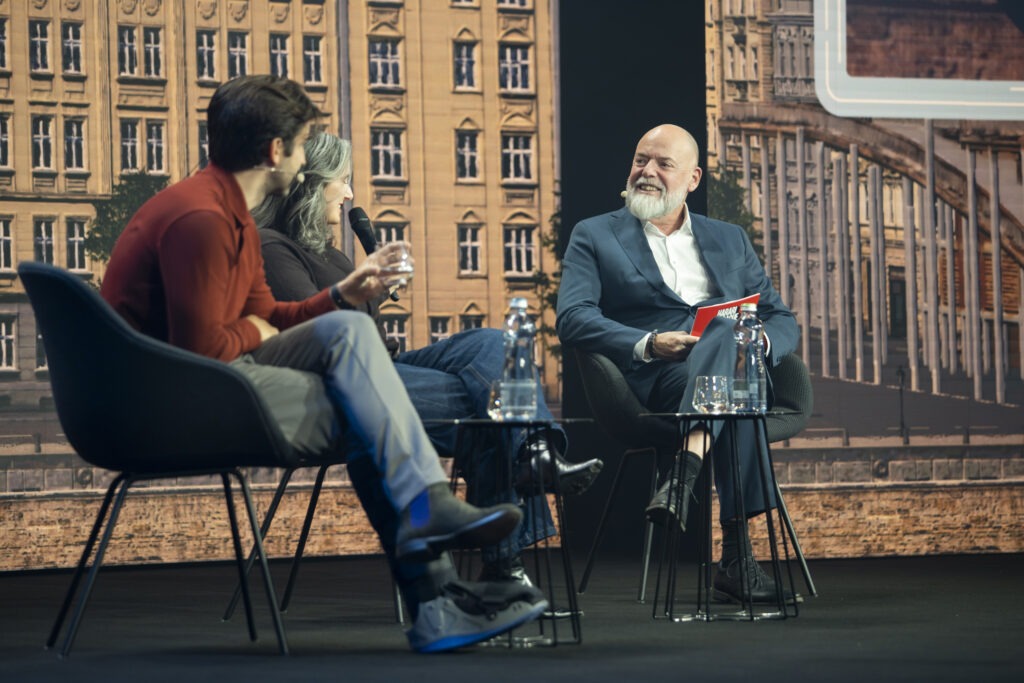
The rise of digital platforms has changed the way information reaches people. Algorithms decide what we see, what catches our attention and what we keep coming back to. On top of that, generative AI makes it dramatically easier to produce texts, images, audio and video that can seem credible even though they do not reflect reality.
The problem, then, is not only that false information spreads. Reaching agreement on what is true, and which sources we can rely on, may itself become increasingly difficult.
Without a shared reality, it is hard to find common solutions to society’s problems. When people trust neither the media, nor institutions, nor one another, they become more vulnerable to manipulation. And it is precisely in such an environment that technological systems can gain even greater influence.
The question of who owns the truth is therefore not just a media issue. It touches on how democracy functions, on trust in the state and on society’s ability to act in moments of crisis.
Resilience Is Not a Luxury. It Is a Condition for Survival.
The conference also devoted considerable space to resilience, the flagship theme of the Solvo Institute. In the panel The Resilience Imperative, Jana Hamanová, Jakub Landovský and Anna Shavit discussed how society can cope with uncertainty and with changes that cannot always be foreseen.
Wars, geopolitical shocks, technological revolutions, economic crises and demographic change no longer unfold separately. Their consequences can multiply. Resilience is therefore not only a matter of the army, infrastructure or state preparedness. It is a quality of the people, institutions and relationships that hold society together.
Solvo has long focused on this topic through its own research and its Resilience Index. The aim is not merely to describe what people fear, but to look for ways to strengthen their ability to cope with pressure and to act even under conditions of uncertainty.
Solvo sees the connection of data, research and public debate as one way to turn general concerns into concrete proposals and decisions.
History Has Not Stopped. And Change Need Not Come Gradually.
In his talk Waves and Breaks: Punctuated World and the Leap Changes, historian Miroslav Bárta offered a perspective on long-term civilisational change. History is not just a story of gradual progress. Societies can develop in a seemingly stable way for a long time and then enter a period of rapid, fundamental transformation.

Such turning points are hard to predict, especially if we view them only through the lens of the present. What we now take for granted as part of how society works may not be a given in ten or twenty years.
The question of the future of the nation state was taken up by Andrzej Nowak, who examined how its role is changing in a shifting world order. In an era of growing geopolitical competition and technological dependence, the question of what state sovereignty actually means, and how it can be preserved, is once again open.
For the Czech Republic, these are practical questions. What role should the state play amid global crises? Which areas must it be able to secure on its own, and where is it more advantageous to cooperate with other European countries?
The future of nation states will not be determined solely by their size or their historical experience. Their ability to respond to change and to make cooperation work to their advantage will also be decisive.
Europe Without Children? Demography as a Question of Future Prosperity
Another part of the programme focused on demography. Barbara Socha and Alexander Braun opened the topic of the demographic challenge, followed by the discussion Can Europe Survive Without Children? with Anna Shavit and Aleš Rod.
Low birth rates are not just a statistic. They affect the future shape of the labour market, the funding of public services, the pension system and intergenerational relations. A society that is unable to renew its population over the long term will have to find new answers to the question of how to sustain economic performance and quality of life.

The debate on demography is often simplified to the question of why people do not have children. In reality, it brings together economic conditions, expectations of life, partnerships and confidence in the future.
For Solvo, this is an example of a topic where simply naming the problem is not enough. We need to understand its causes, compare the experience of other countries and look for measures that can genuinely change the situation.
Migration is also linked to demography. Petr Macinka’s talk in the The Age of Migration block highlighted another of the major issues facing Europe today: how states will deal with population movement, social change and questions of national identity.
Demography and migration are not isolated debates. Together, they shape the future of Europe, its economy and its political decision-making.
Trust in Money, Institutions and the System
After Harari’s talk, the conference programme returned to the question of trust in the practical functioning of society.
In his talk Central Bank. Trust. Daft Punk., Czech National Bank Governor Aleš Michl addressed the central bank, money and trust. This was followed by the debate Can We Still Trust the System?, led by Miroslav Singer together with Jadwiga Emilewicz and Tomáš Spurný, CEO of MONETA Money Bank.
Trust in the currency, banks and public institutions is one of the basic preconditions of a functioning economy. People do not need to understand every mechanism of the financial system, but they do need to trust that institutions act predictably, responsibly and within clear rules.
In an environment of geopolitical uncertainty, rapid technological change and information chaos, this trust becomes even more important. It is not automatic, and it cannot be sustained over the long term by institutional authority alone. It is also built on institutions‘ actual results, their accountability and their ability to explain their own decisions.
This is where the themes of the whole day came together once again. Trust in institutions, the ability to recognise the truth, technological independence and the resilience of society are not separate problems. They influence one another and together determine how well a country will cope with future challenges.
Budoucnost není předem rozhodnutá
The conference Harari in Prague. The Future Is Personal combined a global perspective with questions that have a direct impact on Czech society – from artificial intelligence and the media, through geopolitics and resilience, to demography, migration and economic stability.
Harari offered a view of the forces transforming humanity. The other speakers and panellists showed how such changes play out in the functioning of the state, the economy and society.
For Solvo, it is precisely this connection that matters. Global trends should not remain abstract reflections on the future. We need to understand their concrete consequences, discuss possible scenarios and look for bold, pragmatic solutions grounded in data and experience.
The future will not be shaped only by a handful of technology companies, great powers or political leaders. It will also depend on the decisions made by individual countries, their institutions and the people who live in them.

Napsat komentář