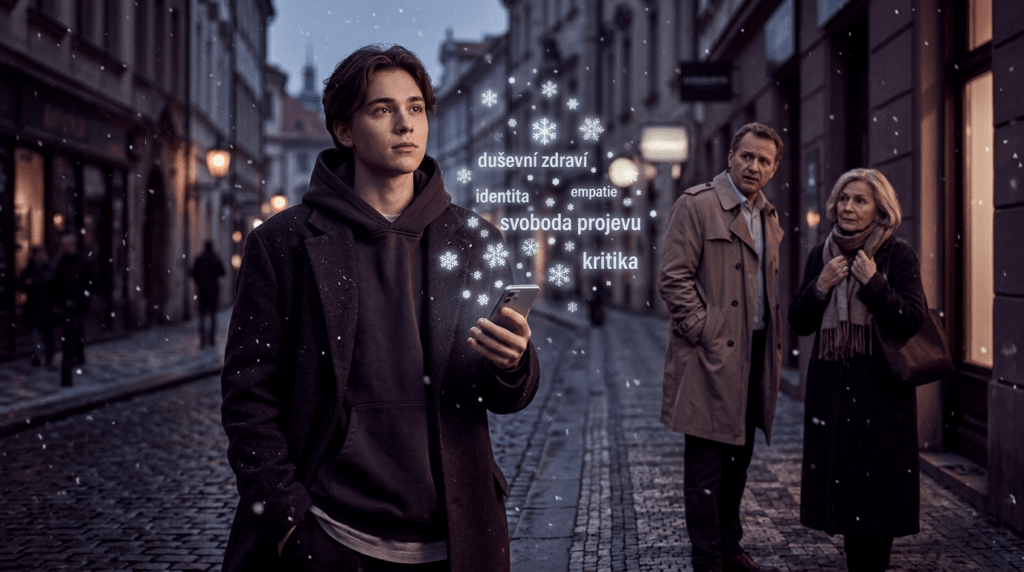

My generation, Gen Z, is often called snowflakes. Unable to withstand anything. But is that true? Personally, I don’t think so. I see a number of implicit factors entering this discussion that people often overlook.
Low Frustration Tolerance
Dr. Radkin Honzák speaks well on this topic, pointing to the phenomenon of lower frustration tolerance among the younger generation. I agree with this claim. What does it actually mean? Frustration tolerance is the ability to withstand frustration without serious disruption to psychophysiological balance and without serious consequences for an individual’s mental health.
Lower frustration tolerance among part of Generation Z can manifest in several ways. One is quicker resignation when encountering obstacles, failure, or prolonged uncertainty. Another is a tendency to avoid unpleasant or stressful situations and to prefer solutions that offer immediate relief or quick gratification. It’s precisely because of these tendencies that Generation Z is often criticized as less resilient to frustration and discomfort.
Honzák points out that part of the problem may be related to the environment in which today’s young people grew up. Unlike previous generations, who were more accustomed to saving, fixing things, or delaying their needs, Generation Z is growing up in a world of instant availability and immediate gratification. Many things can be obtained almost instantly — often at the cost of debt. According to Honzák, this can lead to lower tolerance for waiting and scarcity, and generally a reduced ability to endure prolonged discomfort.
Specific Challenges and Intergenerational Distance
To understand Generation Z, we also need to look at the conditions in which it is growing up. Modern society places enormous pressure on young people to succeed in every aspect of life. They are held responsible for their appearance, their feelings, their choice of partner, their career, and much more. This constant pressure toward perfectionism creates an enormous psychological burden.
I identify with psychiatrist Petr Winkler’s view that Generation Z faces specific challenges. He also points to „mutual intergenerational misunderstanding.“ You encounter people running completely different „software“ than you. This naturally creates enormous pressure, especially on young people who are still forming their identity and need to understand and accept themselves.
Paradoxically, young adults can’t always rely on advice from those close to them. Winkler notes that „young people live in a world where the advice of their parents and grandparents is often somewhat useless, because they lived in a completely different world. The intergenerational distance caused by progress means not only that people are increasingly responsible for their own lives, but also that they have no guidance, nor anywhere to look for it.“
An Uncertain World, Full of Fast and Unexpected Change
So if someone claims Generation Z can’t withstand anything, it’s worth considering whether they’re judging young people by the standards of a world that no longer exists. Navigating today’s world takes considerable effort. It’s no wonder — society is increasingly turbulent and unstable, contributing to far greater uncertainty. This phenomenon can be explained by the VUCA model (Volatility, Uncertainty, Complexity, Ambiguity), which reflects the instability of today’s world.
- Volatility: A rapidly changing world full of uncertainties and unexpected events can lead to feelings of stress and anxiety, weakening psychological resilience.
- Uncertainty: A lack of predictability and a clear vision of the future can trigger feelings of hopelessness and loss of control, fueling depressive thoughts.
- Complexity: The volume of information and stimuli we’re exposed to today can lead to overload and cognitive strain, reducing our ability to cope with problems.
- Ambiguity: Many aspects of modern life are ambiguous and difficult to interpret, which can lead to confusion and helplessness, deepening depressive states.
This doesn’t mean, however, that all of Generation Z’s problems should be explained solely by the surrounding environment. From my perspective, the problem of lower frustration tolerance genuinely exists. Many young people are not used to enduring discomfort, delaying gratification, or facing obstacles over the long term. This can hold us back in many respects.
At the same time, it’s important to see both sides of the same coin. Lower frustration tolerance doesn’t arise in a vacuum. It forms in an environment that, on one hand, offers an unprecedented range of possibilities, but on the other, places enormous demands on young people. We didn’t get to choose the era we were born into. But we do get to decide how we respond to its challenges. This, I believe, is where psychological resilience comes into play.
The Path to Resilience: Learning to Tolerate Uncertainty, Not Avoid It
I like the perspective of Professor Pavel Kolář, whose book Strengthening Through Stress: The Path to Resilience highlights an often-overlooked fact: stress isn’t necessarily only harmful. If a person doesn’t avoid it and learns to work with it, it can become a source of growth and strength. As he writes: „Our body and mind hold enormous potential to make us not only strongly resilient, but also happy. Let’s use that potential and take responsibility for our health and quality of life into our own hands.“
Petr Winkler speaks similarly about resilience: „It’s important to realize that I actually build psychological resilience through my entire life.“ I consider this a key idea. Resilience isn’t a trait you’re born with. It’s an ability you gradually build through how you cope with uncertainty, overcome obstacles, and deal with failure.
This, I believe, is where Generation Z’s greatest challenge lies — not in being weaker than previous generations, but in having to learn to function in a world that is less predictable than ever before. All the more reason not to treat discomfort, uncertainty, or failure as things to be avoided at all costs. They are a natural part of life and, at the same time, one of the main sources of psychological resilience.
From my generation’s perspective, I think it’s important to accept that life’s challenges aren’t obstacles on the path to fulfillment — they’re part of it. As Professor Jiří Horáček often says, a precondition for human fulfillment is learning to tolerate uncertainty, not avoid it.
I think we need to learn to face life’s challenges and accept that not all hardships can be eliminated. The current generation, moreover, often faces intense pressure toward performance and perfection, amplified by social media and a culture of comparison.
All the more reason to recall the ideas of Viktor Frankl, who emphasizes that the key to overcoming suffering isn’t eliminating it, but finding meaning in what we experience. Though this path is difficult, it is precisely there, he argues, that human resilience is born.
I don’t think Generation Z is a generation of „snowflakes.“ It’s a generation growing up in an environment of high uncertainty and performance pressure. But that’s not a reason for resignation — it’s a reason for consciously building resilience. Not because we’re weak, but because we live in a time that demands it.