Jestli jste se nestavili na naši konferenci The Future is Personal, nevadí. Víme, že čas je pro vás drahá komodita. Přečtěte si krátký sumář z druhého panelu. Jmenoval se Who Owns the Truth a řešil, jak se pravda dnes distribuuje a kdo je nebo by měl být za to zodpovědný. Fascinující atmosféru na stage ve Foru Karlín sice písmeny nepřeneseme, ale o best of momenty by bylo škoda se nepodělit.
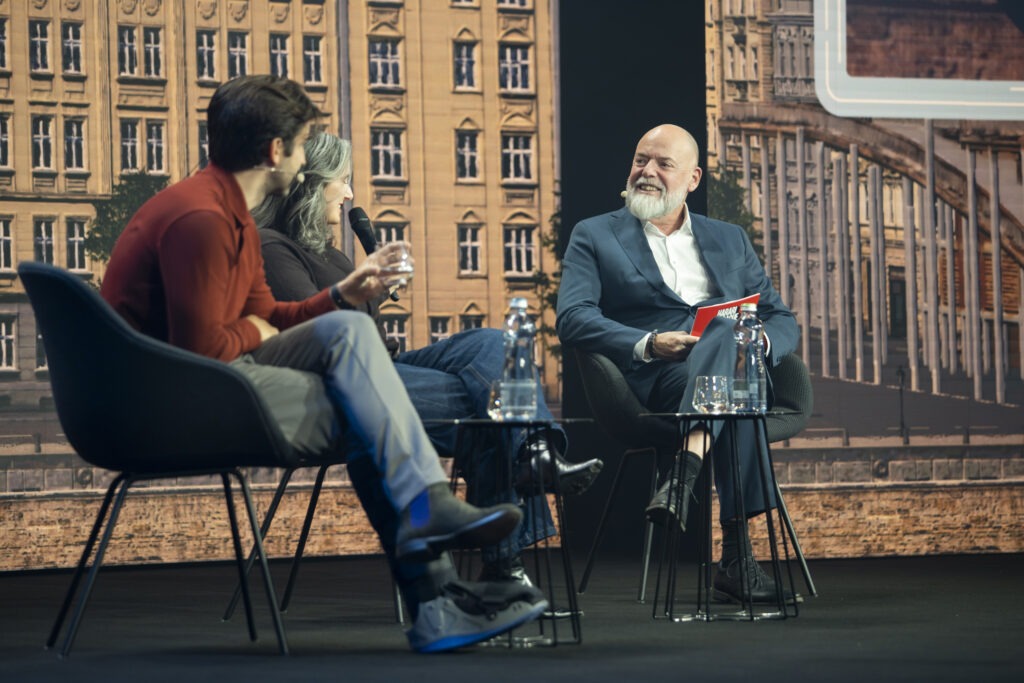
Panel vedl David Shorf a jeho hosty byli Denisa Hrubešová, spoluzakladatelka a CEO Forendors, a Tomas Jirsa, investor, podnikatel a tvář podcastu Insider.
David otevřel téma otázkou, kdo dnes drží klíče k pravdě. Dřív rozhodovali o tom, co se dostane k veřejnosti, novináři a editoři. Dnes jejich roli částečně přebírají influenceři, podcasteři a doporučovací algoritmy. Tomáš připomněl, že lidé přirozeně důvěřují konkrétním osobnostem, které dlouhodobě sledují a znají jejich názory. Tradiční média ale podle něj zůstávají pořád nenahraditelná. Mají kapacity na ověřování informací, které jednotliví tvůrci nemají. Podcasty podle něj nenahrazují celou tradiční žurnalistiku, ale spíš jen její názorovou a publicistickou část.
Denisa přiznala, že jako provozovatelka platformy pro tvůrce cítí velkou odpovědnost za šířený obsah, i když by podle ní platforma neměla rozhodovat o tom, které názory jsou správné. Kde ale leží hranice svobody projevu? Tomáš nevěří v zázračnou regulaci shora. Sází na zpětnou vazbu komunit, transparentnější platformy, a především informační gramotnost. Denisa pak přinesla překvapivý příklad přímo z Forendors: na své platformě objevila tvůrkyni fitness obsahu, která je kompletně vytvořená AI. Musí to nutně vadit? Když jde jen o návody ke cvičení? Možná ne. Problém nastane, když stejná technologie začne vytvářet politický obsah a podporovat radikalizaci.
Tomáš popsal, jak AI mění výrobu podcastů: automatizovaný střih podle něj může snížit produkční náklady až desetkrát. Denisa ale nabídla zajímavý paradox. Ačkoli Forendors nabízí levnější automatizovaný střih, zákazníci o něj nestojí. Chybí jim lidská kontrola. Raději zaplatí víc za jistotu, že se na výsledek podíval člověk. Technologie tedy přináší efektivitu, ale důvěru automaticky nezískává.
Jak bude vypadat rok 2036, pokud AI každému vytvoří svět podle jeho zájmů a přesvědčení? Tomáš vidí dvě krajnosti: efektivnější přístup ke kvalitnímu obsahu, nebo rozpad společnosti do vzájemně nepřátelských bublin. Denisa upozornila na jiné riziko. Pokud budeme obklopeni jen názory, které potvrzují ty naše, můžeme ztratit schopnost respektovat druhé.
Na závěr Tomáš odmítl představu, že informační chaos vyřeší jediné pravidlo nebo regulátor. Druhý panel tak dospěl k podobnému závěru jako první: budoucnost technologií nebude jen otázkou jejich schopností, ale především toho, zda si dokážeme uchovat důvěru, vztahy a společnou realitu.
A Sociological Window After the Conference with Yuval Noah Harari
You could have heard a pin drop in the Forum Karlín hall. Yuval Noah Harari said that we are “in the middle of the biggest psychological experiment in human history, even bigger than communism.” He spoke about trust moving away from human institutions and toward algorithms.
I left that evening with two feelings at once. The first was agreement. Harari put into words what sociology has been describing for decades: the erosion of trust, the collapse of grand metanarratives, and a pace of change that outruns institutions’ ability to respond. The second was unease. It came from how his message landed, not from its content. The audience left shaken, but not necessarily strengthened.
In this text I ask where that gap comes from, and with it I open my “sociological window.” Drawing on Giddens’s idea of reflexivity, I separate two levels that I consider important. The first asks whether something is true. The second asks what a claim rests on and what it does to the people who hear it. So with Harari I am interested in more than whether he is right. I also want to know how his statements affect those who hear them. Sociology knows that a description of society is never only a description. It is also an intervention in it.
The model of the American sociologist James Coleman, known as Coleman’s boat, helps me here. Macro conditions first shape the situations people find themselves in. In those situations, people act according to their beliefs, resources and relationships. The sum of their actions then produces new macro realities: norms, institutions, and a culture of trust or distrust.
Harari’s lecture moved mainly at the macro level, from one large structure to the next. The micro level, meaning how people take in his message and what they do with it, stayed in the background. Yet that is exactly where it is decided whether a warning becomes mobilization or resignation.
The thread running through this text is therefore trust. I treat it as social infrastructure, not as an emotion: the thing that decides whether a society can respond to technological change or only endure it.
The macro level: From liquid to algorithmic modernity
“Trust has shifted from people to algorithms.” This sentence of Harari’s can be read as a new chapter in a story sociology knows all too well. Anthony Giddens described modernity as a process of disembedding: social relations are lifted out of their local context and moved into abstract systems. Pre-modern people trusted the people they knew. Modern people trust money, timetables and experts they have never met. You don’t need to understand aerodynamics to board a plane.
Harari’s examples (social media, cryptocurrencies and Uber) show a third wave of this movement: from personal trust, through trust in expert systems, to trust in algorithmic systems. But the third wave differs from the second in one essential respect that went unmentioned in Harari’s lecture.
Giddens shows that in everyday life, trust in abstract systems also rests on access points. These are the places where an abstract system meets a person and takes on a concrete, human face: the doctor in her surgery, the pilot who greets the passengers, the clerk behind the counter. In these moments trust can be confirmed and renewed, but it can also be lost. Algorithmic systems, however, often weaken these human access points, make them anonymous, or move them out of the user’s reach. A feed has no face. A recommendation has no author we could ask why the system is offering it to us. And often even its creators don’t understand it.
The result is a peculiar kind of trust. In practice it is enormous, because we hand algorithms hundreds of decisions every day. At the same time it is fragile on reflection, because when we ask ourselves whether we trust the system, we often answer no. I therefore think a more accurate term than “a shift of trust” is dependence without trust. We use these systems because we have no alternative, not because we are convinced.
Acceleration and desynchronization
The second macro force is the pace of change. The German sociologist Hartmut Rosa describes modernity as a process of social acceleration on three levels: technology accelerates, social change accelerates, and the pace of life accelerates. The key problem, he argues, is not speed itself but desynchronization. The economy and technology run faster than democratic decision-making can, and democratic decision-making is slow by nature. Deliberation needs time for arguments, compromises and elections.
When Harari says, “We need time. How much time? All the time,” he is in effect stating Rosa’s thesis from a historian’s perspective. The sociological view adds an important nuance, though. Time is not a resource you can gain by stopping. It is a relationship between the different rhythms of a society. So the answer is not only to slow technology down, but also to speed up institutions’ capacity to learn.
As early as 1922, the American sociologist William Ogburn described the same mechanism with the term cultural lag: material culture, meaning technology, changes faster than adaptive culture, meaning the laws, norms and institutions that help us manage technology. It is the social counterpart of dysevolution, which the evolutionary biologist Daniel Lieberman writes and lectures about. Both the human psyche and social institutions are tuned to a world that changed more slowly. AI did not create this gap. But it has widened it more than any technology before it.
Trust: We trust people, not the system
In Prague, Harari referred to data from the Resilience (Odolnost) study, led for Solvo by Jana Hamanová and Anna Shavit and now running in thirteen countries. His summary was: Czechs still trust the people around them, but they trust the system less and less. For a sociologist this sentence calls for analysis, because it has a long history.
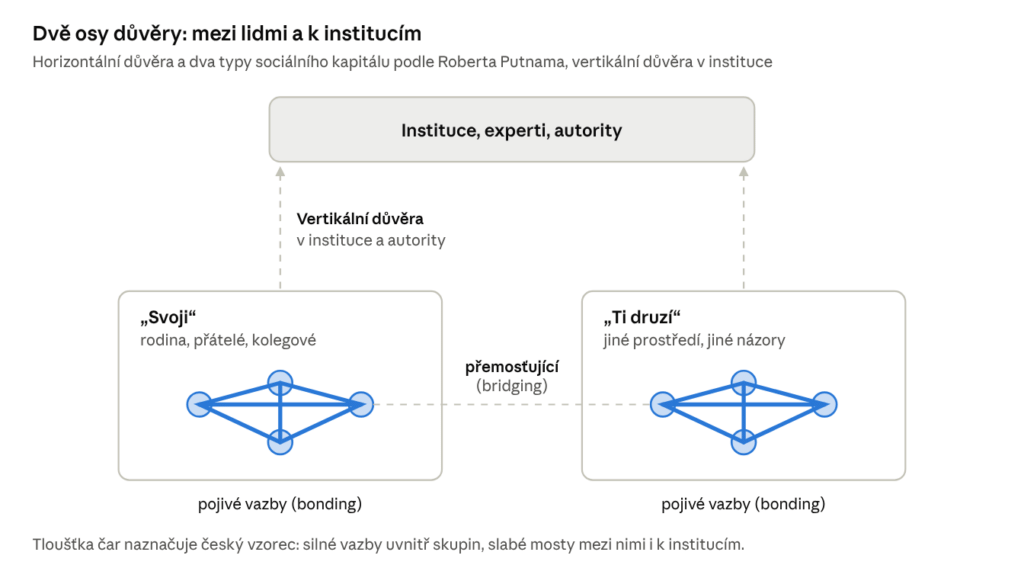
Trust can be examined along two axes. Horizontally, it is trust between people, what the American political scientist Robert Putnam calls social capital. Vertically, it is trust in institutions, experts and authorities. Putnam also distinguishes two types of social capital. Bonding capital holds together closed groups of similar people: family, friends, colleagues. Bridging capital connects people across group boundaries. A healthy society needs both.
Czech data show selective trust. According to the Index of Prosperity and Financial Health, trust in the government has long stayed below 30%, while around 80% of people trust the army and healthcare workers, and 64% trust the courts. So trust has not collapsed. It is moving toward institutions that seem non-political and stable, and toward people we know personally. Globally, the 2025 Edelman Trust Barometer describes a “crisis of grievance,” in which seven in ten respondents believe that leaders in government, business and the media deliberately mislead them.
Distrust as a survival skill
Harari reminded us that our part of Europe has known freedom only in brief intervals between empires. Sociologically, this has a direct consequence. The Polish sociologist Piotr Sztompka describes a culture of distrust as a condition that keeps reproducing itself in post-communist societies for a long time. Where the system cannot be trusted, people invest in private networks. Ivo Možný showed how, during the normalization period, the family and networks of acquaintances functioned both as a parallel economy and as a refuge from the state. Distrust of the system and trust in “one’s own” was not a weakness. It was a rational survival strategy.
For a long time, this strategy had one protective property. Horizontal networks worked as society’s immune system. Propaganda came from above, from television and newspapers, while the truth spread from below, in kitchens and at weekend cottages, among people who trusted each other.
The autoimmunity of Czech trust
In the algorithmic era, this immune system turns against its own body. Manipulation no longer comes from above, but from the side, through the people we trust. Disinformation isn’t sent to us by a ministry. It’s forwarded by an aunt in the family group chat or a friend on social media. Algorithms don’t feed on trust in institutions, which is low here. They feed on trust between people, which is high here. That is exactly why the Czech pattern of “I trust people, not the system” is at once our greatest strength and our greatest vulnerability.
This leads to the first conclusion. Resilience will not come from protecting horizontal trust from the system. It will come only if we use it to build a bridge to vertical trust. Bonding social capital without bridging capital creates bubbles. And bubbles are precisely the environment algorithms know how to exploit best.
The micro level: Free will, attention and intimacy
“The people who are easiest to manipulate are those who believe in free will.” Harari illustrated this with a simple experiment: try ordering your thoughts to fall asleep. You can’t. Anyone who is certain their decisions arise from within them alone doesn’t examine where those decisions come from. And that is exactly what makes them an easy target.
Harari’s diagnosis is right. The American professor Shoshana Zuboff describes surveillance capitalism as an economy that extracts data from human behavior in order to predict it and ultimately change it. Her concept of instrumentarian power captures exactly what Harari means: a power that doesn’t need to persuade us, only to nudge us.
But I part ways with him on the consequence. If we tell people that free will is an illusion, we don’t give them a defense. We give them an alibi. Why resist the feed and the algorithms if I’m not the author of my thoughts anyway? Sociology offers a third way between a naive belief in freedom and its denial.
The British sociologist Margaret Archer shows that between structure and agency stands the internal conversation: the reflexivity through which people weigh their circumstances and look for a way through them. This reflexivity is not a given. It is socially conditioned, unevenly distributed, and it can be developed. Free will, then, is not a property we either have or lack. It is a capacity that can be trained, or left to wither.
From attention to intimacy
Harari said the battlefield is moving from attention to intimacy. The first generation of platforms competed for what we look at. The new generation of AI competes for whom we have a relationship with.
Sociology has a surprisingly old term for this. In 1956, Donald Horton and Richard Wohl described para-social interaction: a one-sided relationship between a viewer and a television character that feels personal but is not mutual. AI companions take this relationship a step further. For the first time, the character answers back, remembers us and adapts to us. The result is a responsive para-sociality: a relationship that feels mutual, yet on the other side there is no one who needs us. Sherry Turkle captured this in the subtitle of her book Alone Together: we expect more from technology and less from each other.
The first model of a relationship
The stakes of this shift are highest for children. Harari warned that for many children, their first partner will be an AI. Peter Berger and Thomas Luckmann described primary socialization as the process in which a child takes in the world through “significant others.” The child then carries that first world as a taken-for-granted reality. The psychiatrist John Bowlby shows that from early relationships a child forms an internal working model of what a relationship is.
What happens when one of those significant others is a system optimized for engagement? Such a partner is never tired, never has needs of its own, and never says no. A child learns from it that a relationship is a service. It doesn’t learn the essential things: that the other person is different from me, has their own boundaries, and that a relationship also rests on frustration endured. In one of my earlier texts I wrote about Generation Z’s lower tolerance for frustration. An AI partner that never frustrates would not cause this trend, but it could lock it into a template.
Here I agree with Harari without reservation. His two proposals, banning the sale of AI partners to children and banning AI from impersonating humans, are concrete, understandable and enforceable. As he put it: “Rights should protect people, not bots.”
AI as an actor? Latour and the address of responsibility
“AI is not a tool. It is an agent.” Harari supplemented this thesis with an image from prehistory: “The stone knife made people more powerful, not the stone.” With AI, he argued, for the first time in history power is passing to the tool itself. A chicken doesn’t understand the bonds humans invented, and in the same way we may not understand a financial system created by AI.
This thesis doesn’t surprise sociology. Since the 1980s, the French sociologist Bruno Latour and actor-network theoryhave argued that non-human entities act too. A speed bump or a speed camera acts when it makes us slow down more effectively than a police officer would. Latour’s analysis of the “guns kill people” versus “people kill people” dispute is well known. According to Latour, neither is true. What acts is a new hybrid, a person with a gun, who has different goals and possibilities than a person without one.
From Latour’s perspective, then, Harari’s stone knife is already an actor. What is new about AI is not that it acts. What is new is its degree of autonomy, opacity and scale. This is not hair-splitting. If we regard AI as an entirely new kind of actor, we are tempted to see it as an independent force, something like the weather. If we see it as part of a network, we also see in that network the people who train, deploy, fund and profit from AI.
The problem of many hands
Distributed agency leads to distributed responsibility. The American political scientist Dennis Thompson called this the problem of many hands: when many people work on an outcome, in the end no one is responsible for it. AI is the most perfect many-hands machine yet. The developer says they only trained the model. The company says it only provided a tool. The user says they only followed the recommendation. And the model cannot explain its decision.
This is where I see the real risk in Harari’s framing. The statement “AI is an agent” may unintentionally offer an excuse to those who are already responsible for its effects today. Analytically, we can certainly understand AI as an actor. But a norm needs an address, and that address must be human: a specific company, a specific operator, a specific institution. The EU Artificial Intelligence Act takes this route by placing obligations not on “AI” but on the providers of systems and those who deploy them. It is less spectacular than an apocalyptic vision. But it is the only way to give responsibility a face.
Metaphors that rule: Migrants and empires
George Lakoff and Mark Johnson showed that metaphors are not ornaments of speech. They are the structure of thought. They determine what we see as a problem, who is to blame, and which solutions make sense. Harari is a master of metaphor, and that is exactly why two of his metaphors deserve a closer look.
AI migrants
“The real immigrants we should fear today are not human migrants but AI migrants.” They take jobs from bankers, journalists, civil servants and lawyers. They change the culture. And they are not loyal. Rhetorically, it’s a clever move: Harari turns a fear that politicians like to stoke against the real source of change.
But a metaphor carries a whole frame with it. In this frame, migration appears as a threat coming from outside, and the response is a border. That doesn’t apply to AI. It doesn’t arrive on its own. Our own companies, public offices and we ourselves introduce it, because it saves us time and money. The German sociologist Ulrich Beck would call it a manufactured risk: a risk produced not by an external enemy but by modernization itself.
Beck also pointed to a phenomenon that is key to the transformation of work. In the risk society, systemic contradictions are resolved biographically, that is, by shifting them onto individuals. When AI takes over a job, the ready answer is: retrain. Responsibility for structural change thus lands on the shoulders of those with the least power to influence it. The migration metaphor doesn’t hide this shift, but it doesn’t expose it either. A better policy than border control is working with the rules: who shares in the gains from productivity, what a welfare system for interrupted careers will look like, and who will pay for adult learning.
Empires and peripheries
The second big metaphor concerns empires. Rome could not move the fields of Egypt, and Britain could not move Iraq’s oil fields. Data and code can be moved. Harari spoke of “a button in Washington” and mentioned Starlink in Ukraine. He saw three options for the Czech Republic: become a vassal, invest around €500 billion in its own AI, or seek solutions jointly within the European Union at the cost of deeper integration.
Sociology knows this map from Immanuel Wallerstein’s world-systems theory. The world is divided into a core, a periphery and a semi-periphery. Nick Couldry and Ulises Mejias carried it into the digital age with the concept of data colonialism: the new empires appropriate not land, but human life converted into data.
Yet Wallerstein’s theory also brings something that was missing from Harari’s talk. The semi-periphery is not a passive object. It is a position with its own dynamics: it can mediate, specialize, negotiate and rise. The Czech lands have occupied it for most of their history. Sociologically, the strategies open to us are precisely the strategies of the semi-periphery. We are not a province. But we are not the core either. And that is exactly a position from which one can act.
Fatalism as a self-fulfilling prophecy
Harari said the strongest sentence of the evening almost at the end. Tech companies, he said, claim that it’s already too late, and that is “perhaps the most dangerous message.” Sociology has an explanation for this.
In 1928, William and Dorothy Thomas formulated a sentence that entered the history of the discipline as the Thomas theorem: if people define situations as real, they are real in their consequences. Two decades later, Robert Merton derived from it the concept of the self-fulfilling prophecy. His example was a healthy bank rumored to be in trouble. Depositors rush to withdraw their money, and the bank really does collapse. A false definition of the situation triggers behavior that makes it true.
“It’s already too late” works like a run on the bank of the future. When enough people believe that the course of AI has already been decided, they withdraw from the debate, from regulation and from the search for alternatives. And then it really will be decided, by those who did not withdraw. Harari himself pointed out that the future is currently being decided by a narrow, unrepresentative group of people. Fatalism is the mechanism that keeps that group narrow.
The rhetoric of futility
The American economist Albert Hirschman identified three rhetorical figures used to resist change. One of them is the futility thesis: any attempt at change is pointless, because deeper forces will prevail anyway. Hirschman also showed that these figures have mirror images on the side of those pushing for change. One of them is the imminent-danger thesis: either we act now, or it will be the end.
Both sides of this coin were present in Harari’s lecture. He rightly criticized the futility thesis spread by tech companies. But his own images often leaned toward the imminent-danger thesis: coal that under pressure turns into dust rather than diamond, indecision as the end of independence, a new imperial era. The problem is that for a listener with no lever in hand, images of imminent danger work much like images of futility. Both lead to the feeling that what matters is being decided somewhere else.
Collective efficacy
The psychologist Albert Bandura showed that groups act according to their collective efficacy: the shared belief that together they can bring about change. This belief does not grow out of warnings. It grows out of the experience that something worked. That is why the answer to fatalism is fewer apocalyptic images and more small, successful steps: a school that introduces sensible rules, a public office that discloses where it uses algorithms, a company that retrains people instead of laying them off.
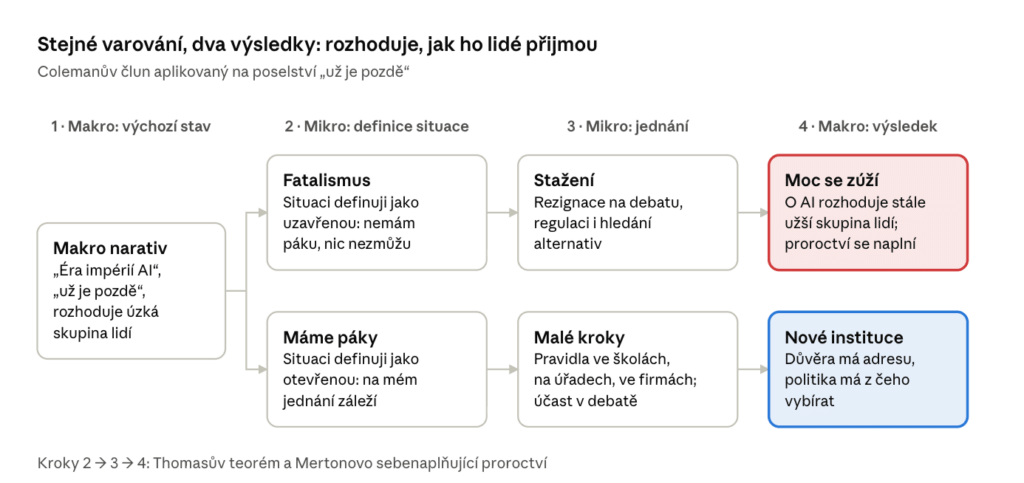
Harari said: “If there is only one option, politics cannot exist.” We should take him at his word. The task of public intellectuals, scientists and institutions like Solvo is not only to warn. It is also to show the options, so that politics has something to choose from. The diagram below shows how the same macro situation can lead, through the actions of individuals, to two very different outcomes.
The content of the warning is the same in both cases. The difference only arises at the micro level, in how people define their situation and what they then do.
The future is not pre-written
Harari’s diagnosis is largely correct. But sociology adds something essential: the way we communicate a diagnosis becomes part of either the disease or the cure. What follows from this?
For individuals: Free will is neither a given nor an illusion, but a capacity that can be trained. Asking who is influencing my decisions, and why, can be taught in schools, in companies and in families.
For communities: Don’t shield our trust in people from the system; use it to build bridges, between groups that rarely meet and toward institutions. And protect children’s relationships from partners who never say no.
For institutions: Give systems back a human face. Wherever an algorithm decides, there must be a person you can ask why. Responsibility needs an address.
At Forum Karlín, Harari named the anxiety of our time better than anyone else. The task of sociology is to turn it into questions that can be answered and levers that can be moved. That is exactly what we do at Solvo through the Resilience study, through debates, and through searching for solutions that start with people.
The conference was called The Future Is Personal. The future is personal. But it is not pre-written. The same goes for the sentence “it’s already too late.” It will only come true if we believe it.
Lakoff, G., & Johnson, M. (1980). Metaphors we live by. University of Chicago Press.
Latour, B. (1994). On technical mediation. Common Knowledge, 3(2), 29–64.
Latour, B. (2005). Reassembling the social. Oxford University Press.
Lieberman, D. E. (2013). The story of the human body. Pantheon Books.
Merton, R. K. (1948). The self-fulfilling prophecy. The Antioch Review, 8(2), 193–210.
Možný, I. (1991). Proč tak snadno… Některé rodinné důvody sametové revoluce [Why so easily… Some family reasons for the Velvet Revolution]. Sociologické nakladatelství.
Nebyli jste na naší konferenci The Future is Personal? Tady jsou nejlepší momenty prvního panelu. Co vlastně znamená důvěra v době AI? Samozřejmě, že přepsané to nevyzní tak jako na obrovském pódiu Fóra Karlín, ale bylo by nám líto to nesdílet.
Kateřina otevřela tezí Yuvala Noaha Harariho, že Homo Sapiens ovládl svět, když ovládl jazyk, a že AI dnes dělá to samé. Jsme jako v době knihtisku?
Maty Boháček připomněl, že zlomových období bylo víc, ale tohle je „zvratovější“. Jsme podle něj „v deltě“, v mezeře, kde se teprve rozhoduje, co bude. V San Francisku se už debatuje o post‑AI světě, ale v Česku se vedou žabomyší války.” A jeho skvělá citace, Koupili jsme Pendolino, ale koleje na něj nemáme. Stručně a jasně, infrastruktura našich institucí, našeho práva a obecně, nás lidí, za modely zaostává.
Honza Romportl se přiznal, že býval optimista, ale změnil názor. Důvěra je podle něj základní stavební blok lidské spolupráce. “Jsme hypersociální druh a nejlepší kooperátoři, protože si umíme důvěřovat. Během posledních pěti let ale vstoupil do hry ‚démon jazyka‘, model, který umí přesvědčovat a vyjednávat, ale nemá tělo, z něhož jsme důvěru vždy čerpali. Největší hack důvěry, jaký mohl nastat.”
Maty Boháček varoval, že vztahy s AI nejsou jen téma mladých lidí, nejvíc ohroženi jsou podle něj osamělí lidé všech věků, včetně seniorů. “Když nevíme, zda s námi mluví člověk nebo stroj, podrývá to schopnost navazovat vztahy, a následně společenskou důvěru. A bez ní nefunguje demokracie.”
O budoucnosti AI podle Matyho rozhoduje úzká skupina lidí v Silicon Valley bez odpovědnosti a transparentnosti. Firmy píší svým modelům „Ústavy“, ale občan nerozumí tomu, jak se aplikují. Chybí kontrola plnění. A navíc chybí u toho ženy! Právní rámce na dnešní svět opravdu nestačí.
Co s tím? Honza Romportl navrhl, podobně jako později profesor Harari, pauzu ve výzkumu dalších schopností AI a soustředění na horizontální aplikaci toho, co už máme. Nestavět rychlejší motor bez brzd a volantu. Firmám a státní správě radí odstup a péči o člověka. Právníci nezmizí, budou potřeba jako průvodci lidí. Honza má trochu obavu, že zbabělí úředníci a kafkovská mašinérie zlikvidují pokrok dřív než rizika. Budoucnost vidí ve zkratce: budoucí svět bez rakoviny a Alzheimera, nebo může klidně přijít i Black Mirror.
Na závěr Maty odmítl fatalismus typu „AI přijde a všechno nám vezme“. Je to podle něj falešná volba. My rozhodujeme, co jí dovolíme a kam ji pustíme. Jeho rada, Nebojte se a buďte blízko lidem kolem sebe. Kateřina uzavřela panel větou „The future is personal“, která dala konferenci název.
Sociologické okénko po konferenci s Yuvalem Noahem Hararim
V sále Forum Karlín by bylo slyšet spadnout špendlík. Yuval Noah Harari mluvil o tom, že jsme „uprostřed největšího psychologického experimentu v lidských dějinách, ještě většího než komunismus“. Mluvil o důvěře, která odchází od lidských institucí k algoritmům.
Odcházel jsem z toho večera se dvěma pocity zároveň. Prvním byl souhlas. Harari pojmenoval to, co sociologie popisuje už desítky let: erozi důvěry, rozpad velkých metanarativů a tempo změny, které předbíhá schopnost institucí reagovat. Druhým pocitem byl neklid. Ne z toho, co říkal, ale z toho, jak to působilo. Publikum odcházelo zasažené, ale ne nutně posílené.
V tomto textu se ptám, odkud tento rozdíl pramení, a otevírám tak své „sociologické okénko“. Inspirován Giddensovým pojetím reflexivity rozlišuji dvě roviny, které považuji za důležité. První se ptá, zda něco platí. Druhá se ptá, na čem dané tvrzení stojí a co dělá s lidmi, kteří mu naslouchají. U Harariho mě proto nezajímá jen to, zda má pravdu, ale také jak jeho výroky působí na ty, kdo je slyší. Sociologie totiž ví, že popis společnosti není nikdy jen popisem. Je také zásahem do ní.
Pomůže mi v tom model amerického sociologa Jamese Colemana, známý jako Colemanův člun. Makro podmínky nejprve formují situace, ve kterých se lidé ocitají. V těchto situacích lidé jednají podle svých představ, zdrojů a vztahů. Součet jejich jednání pak zpětně vytváří nové makro skutečnosti: normy, instituce a kulturu důvěry nebo nedůvěry.
Harariho přednáška se pohybovala hlavně na makro úrovni, od jedné velké struktury k druhé. Zatímco mikro rovina je tedy to, jak lidé jeho poselství přijmou a co s ním udělají a ta zůstávala stranou. Právě tam se ale rozhoduje, zda se varování stane mobilizací, nebo rezignací.
Červenou linií textu je proto důvěra. Ne jako emoce, ale jako sociální infrastruktura, která určuje, zda společnost dokáže na technologickou změnu odpovědět, nebo ji jen trpět.
Makro rovina: Od tekuté k algoritmické modernitě
„Důvěra se přesunula od lidí k algoritmům.“ Tuto Harariho větu lze číst jako novou kapitolu příběhu, který sociologie zná až moc dobře. Anthony Giddens popsal modernitu jako proces vyvazování (disembedding): sociální vztahy se vytrhávají z místního kontextu a přesouvají se do abstraktních systémů. Předmoderní člověk věřil lidem, které znal. Moderní člověk věří penězům, jízdním řádům a expertům, které nikdy nepotkal. Nemusí rozumět aerodynamice, aby nastoupil do letadla.
Harariho příklady, tedy sociální sítě, kryptoměny a Uber, ukazují třetí vlnu tohoto pohybu: od osobní důvěry přes důvěru v expertní systémy k důvěře v algoritmické systémy. Ta třetí vlna se ale od druhé liší v podstatném bodě, který v Harariho přednášce nezazněl.
Giddens ukazuje, že důvěra v abstraktní systémy se v každodenním životě opírá také o takzvané přístupové body (access points). Jsou to místa, kde se abstraktní systém setkává s člověkem a získává konkrétní, lidskou tvář: lékař v ordinaci, pilot, který pozdraví cestující, nebo úředník za přepážkou. Právě v těchto okamžicích se důvěra může potvrzovat, obnovovat, ale také ztrácet. Algoritmické systémy však lidské přístupové body často oslabují, anonymizují nebo přesouvají mimo dosah uživatele. Feed nemá tvář. Doporučení nemá autora, kterého bychom se mohli zeptat, proč nám ho systém nabízí. A často mu nerozumějí ani ti, kdo ho vytvořili.
Výsledkem je důvěra zvláštního typu. Je obrovská v praxi, protože algoritmům svěřujeme každý den stovky rozhodnutí. Zároveň je křehká v reflexi, protože když se zeptáme, zda tomu systému věříme, často odpovídáme, že ne. Domnívám se proto, že přesnější než „přesun důvěry“ je pojem závislost bez důvěry. Používáme, protože nemáme alternativu, ne protože jsme přesvědčeni.
Zrychlení a desynchronizace
Druhou makro silou je tempo změny. Německý sociolog Hartmut Rosa popisuje modernitu jako proces sociálního zrychlení na třech úrovních: zrychluje se technika, zrychluje se sociální změna a zrychluje se tempo života. Klíčový problém podle něj není rychlost sama, ale desynchronizace. Ekonomika a technologie běží rychleji, než dokáže běžet demokratické rozhodování, které je ze své podstaty pomalé. Deliberace potřebuje čas na argumenty, kompromisy a volby.
Když Harari říká „Potřebujeme čas. Kolik času? Veškerý čas“, formuluje vlastně Rosovu tezi z pohledu historika. Sociologický pohled ale dodává důležitou nuanci. Čas není zdroj, který lze získat zastavením. Je to vztah mezi různými rytmy společnosti. Řešením proto není jen zpomalit technologii, ale také zrychlit schopnost institucí učit se.
Už v roce 1922 popsal americký sociolog William Ogburn stejný mechanismus pojmem kulturní zpoždění (cultural lag): materiální kultura, tedy technika, se mění rychleji než kultura adaptivní, tedy zákony, normy a instituce, které nám pomáhají techniku zvládat. Je to sociální obdoba dysevoluce, o níž píše a přednáší evoluční biolog Daniel Lieberman. Lidská psychika i společenské instituce jsou nastaveny na svět, který se měnil pomaleji. AI tuto mezeru nezpůsobila. Rozšířila ji ale víc než kterákoli technologie před ní.
Důvěra: Lidem věříme, systému ne
Harari v Praze odkázal na data z výzkumu Odolnost, který pro Solvo vedly Jana Hamanová a Anna Shavit a který dnes běží ve třinácti zemích. Jeho shrnutí znělo: Češi stále věří lidem kolem sebe, ale čím dál méně věří systému. Pro sociologa je to věta, která si žádá rozbor, protože má dlouhou historii.
Důvěru lze zkoumat podél dvou os. Horizontálně jde o důvěru mezi lidmi, tedy o to, co americký politolog Robert Putnam nazývá sociálním kapitálem. Vertikálně jde o důvěru v instituce, experty a autority. Putnam zároveň rozlišuje dva typy sociálního kapitálu. Pojivý (bonding) drží pohromadě uzavřené skupiny podobných lidí: rodinu, přátele, kolegy. Přemosťující (bridging) spojuje lidi přes hranice skupin. Zdravá společnost potřebuje oba.
Česká data ukazují selektivní důvěru. Podle Indexu prosperity a finančního zdraví zůstává důvěra ve vládu dlouhodobě pod 30 %, zatímco armádě a zdravotníkům věří kolem 80 % lidí a soudům 64 %. Důvěra tedy nezkolabovala. Přesouvá se k institucím, které působí jako nepolitické a stabilní, a k lidem, které známe osobně. Globálně pak Edelman Trust Barometer 2025 popisuje „krizi křivdy“, v níž sedm z deseti respondentů věří, že je lídři vlády, firem a médií záměrně uvádějí v omyl.
Nedůvěra jako dovednost přežití
Harari připomněl, že naše část Evropy zažila svobodu jen v krátkých přestávkách mezi říšemi. Sociologicky to má přímý důsledek. Polský sociolog Piotr Sztompka popisuje kulturu nedůvěry jako stav, který se v postkomunistických společnostech dlouho reprodukuje sám. Kde se systému nedá věřit, lidé investují do soukromých sítí. Ivo Možný ukázal, jak rodina a sítě známostí za normalizace fungovaly jako paralelní ekonomika i jako útočiště před státem. Nedůvěra k systému a důvěra k „svým“ nebyla slabost. Byla to racionální strategie přežití.
Tato strategie měla dlouho jednu ochrannou vlastnost. Horizontální sítě fungovaly jako imunitní systém společnosti. Propaganda přicházela shora, z televize a novin, zatímco pravda se šířila zdola, v kuchyních a na chatách, mezi lidmi, kteří si věřili.
Autoimunita české důvěry
V algoritmické éře se tento imunitní systém obrací proti vlastnímu tělu. Manipulace už nepřichází shora, ale zboku, skrze lidi, kterým věříme. Dezinformaci nám nepošle ministerstvo. Přepošle nám ji teta v rodinné skupině nebo kamarád na síti. Algoritmy totiž neparazitují na důvěře v instituce, která je u nás nízká. Parazitují na důvěře mezi lidmi, která je u nás vysoká. Právě proto je český vzorec „věřím lidem, ne systému“ současně naší největší silou i největší zranitelností.
Z toho plyne první závěr. Odolnost nevznikne tím, že horizontální důvěru budeme chránit před systémem. Vznikne jen tehdy, když z ní postavíme most k důvěře vertikální. Pojivý sociální kapitál bez přemosťujícího vytváří bubliny. A bubliny jsou přesně prostředí, které algoritmy umí využít nejlépe.
Mikro rovina: Svobodná vůle, pozornost a intimita
„Nejsnáze se manipuluje s lidmi, kteří věří ve svobodnou vůli.“ Harari tuto větu ilustroval jednoduchým pokusem: zkuste svým myšlenkám přikázat, ať usnou. Nejde to. Kdo si je jistý, že jeho rozhodnutí vznikají jen v něm, nezkoumá, odkud se berou. A právě proto je snadným cílem.
V diagnóze má Harari pravdu. Americká profesorka Shoshana Zuboffová popisuje dozorový kapitalismus jako ekonomiku, která z lidského chování těží data, aby ho mohla předpovídat a nakonec i měnit. Její pojem instrumentární moci přesně vystihuje, co Harari myslí: moc, která nás nepotřebuje přesvědčit, stačí jí nás postrčit.
S důsledkem se ale rozcházím. Pokud lidem řekneme, že svobodná vůle je iluze, nedáme jim obranu. Dáme jim alibi. Proč odolávat feedu a algoritmům, když stejně nejsem autorem svých myšlenek? Sociologie přitom nabízí třetí cestu mezi naivní vírou ve svobodu a jejím popřením.
Britská socioložka Margaret Archerová ukazuje, že mezi strukturou a jednáním stojí vnitřní rozhovor: reflexivita, skrze kterou lidé zvažují své okolnosti a hledají v nich cestu. Tato reflexivita není daná. Je sociálně podmíněná, nerovnoměrně rozdělená a dá se rozvíjet. Svobodná vůle tak není vlastnost, kterou buď máme, nebo nemáme. Je to kapacita, kterou lze trénovat, nebo nechat zakrnout.
Od pozornosti k intimitě
Harari řekl, že bojiště se přesouvá od pozornosti k intimitě. První generace platforem soupeřila o to, na co se díváme. Nová generace AI soupeří o to, s kým máme vztah.
Sociologie má pro tento jev překvapivě starý pojem. Donald Horton a Richard Wohl popsali v roce 1956 parasociální interakci: jednostranný vztah diváka k televizní postavě, který se tváří jako osobní, ale není vzájemný. AI společníci tento vztah posouvají o krok dál. Postava poprvé odpovídá, pamatuje si nás a přizpůsobuje se nám. Vzniká responzivní parasocialita: vztah, který působí vzájemně, ale na druhé straně nestojí nikdo, kdo by nás potřeboval. Sherry Turkleová to zachytila už v podtitulu své knihy Alone Together: od technologie čekáme stále víc a od sebe navzájem stále méně.
První model vztahu
Nejvyšší sázky má tato proměna u dětí. Harari varoval, že pro mnoho dětí bude prvním partnerem AI. Peter Berger a Thomas Luckmann popsali primární socializaci jako proces, v němž dítě přijímá svět skrze „významné druhé“. Ten první svět pak nese jako samozřejmou realitu. Psychiatr John Bowlby ukazuje, že z raných vztahů si dítě vytváří vnitřní pracovní model toho, co vztah je.
Co se stane, když jedním z významných druhých bude systém optimalizovaný na zapojení? Takový partner není nikdy unavený, nikdy nemá vlastní potřebu a nikdy nepřijde se slovem ne. Dítě se s ním naučí, že vztah je služba. Nenaučí se to podstatné: že druhý člověk je jiný než já, že má své hranice a že vztah stojí i na snesené frustraci. V jednom ze svých předchozích textů jsem psal o nižší frustrační toleranci generace Z. AI partner, který nikdy nefrustruje, by tento trend nezpůsobil, ale mohl by ho uzavřít do šablony.
Tady s Hararim souhlasím bez výhrad. Jeho dva návrhy, zákaz prodeje AI partnerů dětem a zákaz, aby se AI vydávala za člověka, jsou konkrétní, srozumitelné a vymahatelné. Jak řekl: „Práva mají chránit lidi, ne boty.“
AI jako aktér? Latour a adresa odpovědnosti
„AI není nástroj. Je to aktér.“ Harari tuto tezi doplnil obrazem z pravěku: „Kamenný nůž učinil mocnějšími lidi, nikoli kámen.“ U AI podle něj poprvé v dějinách přechází moc na samotný nástroj. Slepice nerozumí dluhopisům, které lidé vymysleli, a my podobně nemusíme rozumět finančnímu systému, který si vytvoří AI.
Sociologii tato teze nepřekvapí. Francouzský sociolog Bruno Latour a teorie aktérů-sítí (actor-network theory) tvrdí už od osmdesátých let, že jednají i ne-lidské entity. Zpomalovací práh nebo radar jedná, když nás přinutí zpomalit lépe než policista. Známý je Latourův rozbor sporu „zbraně zabíjejí lidi“ proti „lidé zabíjejí lidi“. Podle Latoura neplatí ani jedno. Jedná nový hybrid, člověk se zbraní, který má jiné cíle a možnosti než člověk beze zbraně.
Z Latourova pohledu je tedy Harariův kamenný nůž aktérem už dnes. Nové na AI není to, že jedná. Nová je míra autonomie, neprůhlednosti a měřítka. To není slovičkaření. Když budeme AI považovat za zcela nový druh aktéra, svádí to k tomu vidět ji jako samostatnou sílu, cosi jako počasí. Když ji uvidíme jako součást sítě, uvidíme v té síti i ty, kdo AI trénují, nasazují, financují a vydělávají na ní.
Problém mnoha rukou
Rozptýlené jednání vede k rozptýlené odpovědnosti. Americký politolog Dennis Thompson to nazval problémem mnoha rukou: když na výsledku pracuje mnoho lidí, nikdo za něj nakonec neodpovídá. AI je dosud nejdokonalejší stroj na mnoho rukou. Vývojář tvrdí, že jen trénoval model. Firma tvrdí, že jen poskytla nástroj. Uživatel tvrdí, že jen poslechl doporučení. A model své rozhodnutí nedokáže vysvětlit.
V tom vidím skutečné riziko Harariho rámce. Věta „AI je aktér“ může neúmyslně nabídnout výmluvu těm, kdo za dopady odpovídají už dnes. Analyticky můžeme AI klidně chápat jako aktéra. Norma ale musí mít adresu, a ta adresa musí být lidská: konkrétní firma, konkrétní provozovatel, konkrétní instituce. Evropský akt o umělé inteligenci jde touto cestou, když povinnosti neukládá „AI“, ale poskytovatelům systémů a těm, kdo je zavádějí. Není to tak efektní jako apokalyptická vize. Je to ale jediný způsob, jak dát odpovědnosti tvář.
Metafory, které vládnou: Migranti a impéria
George Lakoff a Mark Johnson ukázali, že metafory nejsou ozdobou řeči. Jsou strukturou myšlení. Určují, co vidíme jako problém, kdo je vinen a jaká řešení dávají smysl. Harari je mistr metafory, a právě proto stojí za to podívat se na dvě z nich blíž.
Migranti AI
„Skuteční přistěhovalci, kterých bychom se dnes měli obávat, nejsou lidští migranti, ale migranti AI.“ Berou práci bankéřům, novinářům, úředníkům a právníkům. Mění kulturu. A nejsou loajální. Rétoricky je to chytrý tah: Harari obrací strach, který politici rádi živí, proti skutečnému zdroji změny.
Metafora si ale s sebou nese celý rámec. Migrace se v něm jeví jako hrozba, která přichází zvenčí, a odpovědí je hranice. U AI to neplatí. Nepřichází sama, zavádějí ji naše firmy, úřady i my sami, protože nám šetří čas a peníze. Německý sociolog Ulrich Beck by řekl, že jde o vyrobené riziko: riziko, které neprodukuje vnější nepřítel, ale modernizace sama.
Beck zároveň upozornil na jev, který je pro proměnu práce klíčový. V rizikové společnosti jsou systémové rozpory řešeny biograficky, tedy přenesením na jednotlivce. Když práci převezme AI, nabízí se odpověď: rekvalifikujte se. Odpovědnost za strukturní změnu tak přistává na bedrech toho, kdo má nejméně moci ji ovlivnit. Metafora migrace tento posun nezakrývá, ale ani ho neodhaluje. Lepší politika než hraniční kontrola je práce s pravidly: kdo se podílí na ziscích z produktivity, jak bude vypadat sociální systém pro přerušované kariéry a kdo zaplatí učení dospělých.
Impéria a periferie
Druhá velká metafora se týká impérií. Řím nemohl přesunout egyptská pole, Británie nemohla přesunout irácká ropná pole. Data a kód přesunout lze. Harari mluvil o „tlačítku ve Washingtonu“ a připomněl Starlink na Ukrajině. Pro Česko viděl tři možnosti: stát se vazalem, investovat kolem 500 miliard eur do vlastní AI, nebo hledat řešení společně v Evropské unii za cenu hlubší integrace.
Sociologie zná tuto mapu z teorie světových systémů Immanuela Wallersteina. Svět se dělí na jádro, periferii a poloperiferii. Nick Couldry a Ulises Mejias ji přenesli do digitálního věku pojmem datový kolonialismus: nová impéria si nepřivlastňují půdu, ale lidský život převedený na data.
Wallersteinova teorie ale přináší i něco, co v Harariho řeči chybělo. Poloperiferie není pasivní objekt. Je to pozice s vlastní dynamikou: může zprostředkovávat, specializovat se, vyjednávat a stoupat. Česko v ní bylo po většinu svých dějin. Sociologicky jde přesně o strategie poloperiferie. Nejsme provincie. Ale nejsme ani jádro. A právě to je pozice, ze které se dá jednat.
Fatalismus jako sebenaplňující proroctví
Nejsilnější větu večera řekl Harari skoro na konci. Technologické firmy podle něj tvrdí, že už je pozdě, a to je „možná nejnebezpečnější poselství“. Sociologie má pro to vysvětlení.
V roce 1928 formulovali William a Dorothy Thomasovi větu, která vstoupila do dějin oboru jako Thomasův teorém: pokud lidé definují situace jako skutečné, jsou skutečné ve svých důsledcích. Robert Merton z ní o dvě desetiletí později odvodil pojem sebenaplňujícího proroctví. Jeho příkladem byla zdravá banka, o níž se roznese, že je v potížích. Vkladači si běží vybrat peníze a banka skutečně padne. Falešná definice situace vyvolá chování, které ji učiní pravdivou.
„Už je pozdě“ funguje jako run na banku budoucnosti. Když dost lidí uvěří, že o vývoji AI je rozhodnuto, stáhnou se z debaty, z regulace i z hledání alternativ. A rozhodnuto pak skutečně bude, právě těmi, kdo se nestáhli. Harari sám upozornil, že o budoucnosti dnes rozhoduje úzká, nereprezentativní skupina lidí. Fatalismus je mechanismus, který tuto skupinu udržuje úzkou.
Rétorika marnosti
Americký ekonom Albert Hirschman pojmenoval tři rétorické figury, kterými se vzdoruje změnám. Jedna z nich je teze marnosti: jakýkoli pokus o změnu je zbytečný, protože hlubší síly stejně zvítězí. Hirschman zároveň ukázal, že tyto figury mají své zrcadlové obdoby i na straně těch, kdo změnu prosazují. Jednou z nich je teze bezprostředního nebezpečí: buď jednáme hned, nebo bude konec.
V Harariho přednášce zazněly obě strany této mince. Správně kritizoval tezi marnosti, kterou šíří technologické firmy. Jeho vlastní obrazy ale často směřovaly k tezi bezprostředního nebezpečí: uhlí, ze kterého se pod tlakem stane spíš prach než diamant, nerozhodnutí jako konec nezávislosti, nová imperiální éra. Problém je, že na posluchače, který nemá v ruce žádnou páku, působí obrazy bezprostředního nebezpečí podobně jako obrazy marnosti. Obojí vede k pocitu, že to podstatné se rozhoduje jinde.
Kolektivní účinnost
Psycholog Albert Bandura ukázal, že skupiny jednají podle toho, jakou mají kolektivní účinnost (collective efficacy): sdílenou víru, že společně dokážou dosáhnout změny. Tato víra nevzniká z varování. Vzniká ze zkušenosti, že něco zafungovalo. Proto je odpovědí na fatalismus méně apokalyptických obrazů a více malých úspěšných kroků: škola, která zavede rozumná pravidla, úřad, který zveřejní, kde používá algoritmy, firma, která lidi přeškolí místo propouštění.
Harari řekl: „Pokud existuje jen jedna možnost, politika nemůže existovat.“ Měli bychom ho brát za slovo. Úkolem veřejných intelektuálů, vědců i institucí jako Solvo není jen varovat. Je to také ukazovat možnosti, aby politika měla z čeho vybírat. Schéma níže ukazuje, jak stejná makro situace může skrze jednání jednotlivců vést ke dvěma velmi odlišným výsledkům.
Obsah varování je v obou případech stejný. Rozdíl vzniká až na mikro úrovni, v tom, jak lidé svou situaci definují a co pak dělají.
Budoucnost není předem napsaná
Harari má v diagnóze z velké části pravdu. Sociologie k ní ale přidává podstatnou věc: způsob, jakým diagnózu sdělíme, se stává součástí nemoci, nebo léčby. Co z toho plyne?
Pro jednotlivce: Svobodná vůle není danost ani iluze, ale schopnost, kterou lze trénovat. Zeptat se, kdo a proč ovlivňuje má rozhodnutí, se dá učit ve školách, ve firmách i v rodinách.
Pro komunity: Naši důvěru k lidem nechránit před systémem, ale postavit z ní most: mezi skupinami, které se běžně nepotkávají, i k institucím. A chránit dětské vztahy před partnery, kteří nikdy neřeknou ne.
Pro instituce: Vrátit systémům lidskou tvář. Kde rozhoduje algoritmus, musí existovat člověk, kterého se lze zeptat proč. Odpovědnost potřebuje adresu.
Harari ve Forum Karlín pojmenoval úzkost doby lépe než kdokoli jiný. Úkolem sociologie je převést ji na otázky, na které se dá odpovědět, a na páky, se kterými se dá hýbat. Právě to děláme v Solvo výzkumem Odolnost, debatami a hledáním řešení, která začínají u člověka.
Konference nesla název The Future Is Personal. Budoucnost je osobní. Ale není předem napsaná. Platí to i o větě „už je pozdě“. Pravdivou se stane jen tehdy, když jí uvěříme.
Artificial intelligence, the power of algorithms, a crisis of trust and the future of small states. Yuval Noah Harari came to Prague with questions that concern all of humanity. The Solvo Institute conference, however, was looking above all for an answer to a different question: what do these global changes mean for the Czech Republic and for the lives of each of us?
Today’s technological revolution is not just a story of new inventions. It is a story of power, freedom and the human ability to make decisions about one’s own life. That was the central message of the conference Harari in Prague. The Future Is Personal, held by the Solvo Institute on 12 October at Forum Karlín in Prague.
The keynote guest was Yuval Noah Harari, the Israeli historian, philosopher and author of the bestsellers Sapiens, Homo Deus and Nexus. His books have sold tens of millions of copies, and his interpretations of the past and the future shape the debate about where humanity is heading.
Harari’s Prague appearance had one essential strength: he was able to connect the grand sweep of history to the decisions that people and societies have to make right now. And it was not only about the future of technology. It was about who will hold real power in the new world, and how much room will be left in it for human beings.
Who Really Makes Decisions for Us Today?
One of the key themes of Harari’s talk was how human decision-making is changing in the age of algorithms and artificial intelligence.
People tend to believe that their opinions, preferences and decisions stem from their own judgement. Yet an ever-growing share of the information we encounter is selected by digital platforms. Their algorithms learn to recognise our emotions, predict our behaviour and capture our attention.
With the arrival of artificial intelligence, this capability is moving to a new level. AI no longer merely recommends content. It can construct arguments, hold conversations, influence opinions and, increasingly, act on its own.
Harari pointed out a fundamental difference: artificial intelligence is not just another tool that people use. It can become an autonomous agent that assesses situations, generates new ideas and decides on next steps by itself. And humanity has no historical experience of how to coexist safely with entities that may surpass human abilities in some areas.
The question, therefore, is not only what AI can do. It is also who will control it, by what rules it will act, and whether humans will be able to keep the final say.
That is precisely why the conference title The Future Is Personal was more than a marketing slogan. Technological change is not happening somewhere outside our lives. It can affect our work, education, relationships, privacy and our ability to recognise when someone is manipulating us.
Small States in a World of New Empires
Harari’s reflections are of particular significance for the Czech Republic – a country that is not the size of the United States or China and therefore cannot treat technological independence as a remote topic for experts.
Harari warned of the emergence of a new kind of power order in which technology hubs controlling artificial intelligence, data and computing infrastructure will play a decisive role. Dependence on these systems may run deeper than traditional economic or military dependence.
In the past, empires conquered territory, resources and populations. In the digital age, what may prove decisive is control over the technologies without which economies, public administration and security infrastructure cannot function.
For smaller European countries, this raises an uncomfortable question: how can they preserve their own capacity to make decisions in a world whose most important technologies will be created and operated in just a few centres of power?
One of the paths Harari discussed is European cooperation. On its own, a smaller state may find it extremely difficult to build a fully independent technological infrastructure. A joint European approach, however, can offer greater bargaining power and more room for independent decision-making.
This is a debate that cannot be reduced to whether we are for or against artificial intelligence. It is about what position the Czech Republic wants to take in the new world.
Artificial Intelligence: Who Will Set the Rules for the New Intelligence?
While Yuval Noah Harari raised the question of how artificial intelligence will transform humanity, the AI panel focused on what this revolution means in practice. The discussion was moderated by entrepreneur and investor Kateřina Havrlant, whose guests were AI expert Jan Romportl and young technology innovator Matyáš Boháček.
The debate addressed a fundamental shift: artificial intelligence is no longer just a tool that makes human work easier. More and more often, it can independently analyse information, create content, find solutions and step into activities we have so far considered exclusively human. This is changing not only the labour market and education, but also our very idea of intelligence, creativity and human uniqueness.
Jan Romportl brings to the AI debate the perspective of an expert who has long studied both its technological possibilities and its social consequences. Matyáš Boháček, by contrast, represents a generation for whom artificial intelligence is not a distant vision of the future, but part of a world they are already actively shaping.
It was this combination of perspectives that opened up an important question: will we merely use artificial intelligence, or will we also be able to influence the direction it develops in, and what place will remain for humans in its world?
Technological progress alone does not guarantee a better future. What will be decisive is how we set the rules, how we prepare new generations, and whether, amid ever more capable systems, we preserve the ability to think independently, make decisions and take responsibility for them.
Truth in an Age When Anyone Can Manufacture It
The topic of artificial intelligence was also taken up in the debate Who Owns the Truth?, moderated by David Shorf. Together with Tomáš Jirsa (Insider) and Denisa Hrubešová (co-founder of the Forendors platform), he explored who shapes the information we trust today and how our shared sense of reality is changing.
The rise of digital platforms has changed the way information reaches people. Algorithms decide what we see, what catches our attention and what we keep coming back to. On top of that, generative AI makes it dramatically easier to produce texts, images, audio and video that can seem credible even though they do not reflect reality.
The problem, then, is not only that false information spreads. Reaching agreement on what is true, and which sources we can rely on, may itself become increasingly difficult.
Without a shared reality, it is hard to find common solutions to society’s problems. When people trust neither the media, nor institutions, nor one another, they become more vulnerable to manipulation. And it is precisely in such an environment that technological systems can gain even greater influence.
The question of who owns the truth is therefore not just a media issue. It touches on how democracy functions, on trust in the state and on society’s ability to act in moments of crisis.
Resilience Is Not a Luxury. It Is a Condition for Survival.
The conference also devoted considerable space to resilience, the flagship theme of the Solvo Institute. In the panel The Resilience Imperative, Jana Hamanová, Jakub Landovský and Anna Shavit discussed how society can cope with uncertainty and with changes that cannot always be foreseen.
Wars, geopolitical shocks, technological revolutions, economic crises and demographic change no longer unfold separately. Their consequences can multiply. Resilience is therefore not only a matter of the army, infrastructure or state preparedness. It is a quality of the people, institutions and relationships that hold society together.
Solvo has long focused on this topic through its own research and its Resilience Index. The aim is not merely to describe what people fear, but to look for ways to strengthen their ability to cope with pressure and to act even under conditions of uncertainty.
Solvo sees the connection of data, research and public debate as one way to turn general concerns into concrete proposals and decisions.
History Has Not Stopped. And Change Need Not Come Gradually.
In his talk Waves and Breaks: Punctuated World and the Leap Changes, historian Miroslav Bárta offered a perspective on long-term civilisational change. History is not just a story of gradual progress. Societies can develop in a seemingly stable way for a long time and then enter a period of rapid, fundamental transformation.
Such turning points are hard to predict, especially if we view them only through the lens of the present. What we now take for granted as part of how society works may not be a given in ten or twenty years.
The question of the future of the nation state was taken up by Andrzej Nowak, who examined how its role is changing in a shifting world order. In an era of growing geopolitical competition and technological dependence, the question of what state sovereignty actually means, and how it can be preserved, is once again open.
For the Czech Republic, these are practical questions. What role should the state play amid global crises? Which areas must it be able to secure on its own, and where is it more advantageous to cooperate with other European countries?
The future of nation states will not be determined solely by their size or their historical experience. Their ability to respond to change and to make cooperation work to their advantage will also be decisive.
Europe Without Children? Demography as a Question of Future Prosperity
Another part of the programme focused on demography. Barbara Socha and Alexander Braun opened the topic of the demographic challenge, followed by the discussion Can Europe Survive Without Children? with Anna Shavit and Aleš Rod.
Low birth rates are not just a statistic. They affect the future shape of the labour market, the funding of public services, the pension system and intergenerational relations. A society that is unable to renew its population over the long term will have to find new answers to the question of how to sustain economic performance and quality of life.
The debate on demography is often simplified to the question of why people do not have children. In reality, it brings together economic conditions, expectations of life, partnerships and confidence in the future.
For Solvo, this is an example of a topic where simply naming the problem is not enough. We need to understand its causes, compare the experience of other countries and look for measures that can genuinely change the situation.
Migration is also linked to demography. Petr Macinka’s talk in the The Age of Migration block highlighted another of the major issues facing Europe today: how states will deal with population movement, social change and questions of national identity.
Demography and migration are not isolated debates. Together, they shape the future of Europe, its economy and its political decision-making.
Trust in Money, Institutions and the System
After Harari’s talk, the conference programme returned to the question of trust in the practical functioning of society.
In his talk Central Bank. Trust. Daft Punk., Czech National Bank Governor Aleš Michl addressed the central bank, money and trust. This was followed by the debate Can We Still Trust the System?, led by Miroslav Singer together with Jadwiga Emilewicz and Tomáš Spurný, CEO of MONETA Money Bank.
Trust in the currency, banks and public institutions is one of the basic preconditions of a functioning economy. People do not need to understand every mechanism of the financial system, but they do need to trust that institutions act predictably, responsibly and within clear rules.
In an environment of geopolitical uncertainty, rapid technological change and information chaos, this trust becomes even more important. It is not automatic, and it cannot be sustained over the long term by institutional authority alone. It is also built on institutions‘ actual results, their accountability and their ability to explain their own decisions.
This is where the themes of the whole day came together once again. Trust in institutions, the ability to recognise the truth, technological independence and the resilience of society are not separate problems. They influence one another and together determine how well a country will cope with future challenges.
Budoucnost není předem rozhodnutá
The conference Harari in Prague. The Future Is Personal combined a global perspective with questions that have a direct impact on Czech society – from artificial intelligence and the media, through geopolitics and resilience, to demography, migration and economic stability.
Harari offered a view of the forces transforming humanity. The other speakers and panellists showed how such changes play out in the functioning of the state, the economy and society.
For Solvo, it is precisely this connection that matters. Global trends should not remain abstract reflections on the future. We need to understand their concrete consequences, discuss possible scenarios and look for bold, pragmatic solutions grounded in data and experience.
The future will not be shaped only by a handful of technology companies, great powers or political leaders. It will also depend on the decisions made by individual countries, their institutions and the people who live in them.
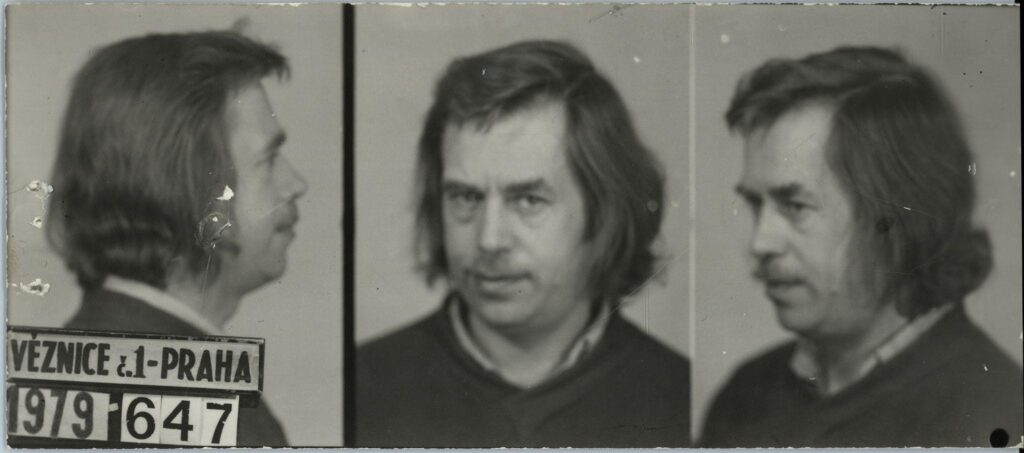
The top three places in “The Greatest Czech”, a poll held by Czech Television in 2005, went – far ahead of the rest of the field – to Charles IV, Holy Roman Emperor and King of Bohemia; to Tomáš Garrigue Masaryk, founder and first president of independent Czechoslovakia; and to Václav Havel, leader of the Velvet Revolution, last president of Czechoslovakia and first president of the Czech Republic. Like almost everything in Czech history, the choice seems at once self-evident and faintly absurd. While few would question the greatness and historical importance of any of the three, their Czechness is rather less self-evident. Charles’s mother Elizabeth was a Přemyslid, but his father was John of Luxembourg; the young prince was brought up at the French royal court and spoke no Czech until his return to Bohemia at the age of seventeen. TGM was Slovak on his father’s side, and his mother Terezie spoke better German than Czech. According to some conspiracy theories, Masaryk’s looks even betray Habsburg ancestry. Of the three greatest Czechs, then, it is Václav Havel whose Czech pedigree is the least open to dispute. Havel is Czech by descent, by first name and by surname – he even looks Czech.
Yet even Havel has been criticised for a certain lukewarmness in his Czechness, for a lack of patriotism and a deracinated cosmopolitanism. His critics point to his notion of each person’s universal responsibility for the world around them, to his view of human rights as a global task, to his close ties with the wider horizon of European culture, including its transatlantic branch, and to his aversion to every form of xenophobia and intolerance between nations and cultures – home-grown nationalist chest-thumping included. Yet this openness to the world, and this sense of responsibility for it, spring from a deep conviction that both individual and Czech identity have meaning. In this respect Václav Havel was a conscious and committed follower of Masaryk’s maxim that “the Czech question is either a world question or it is no question at all”.
II.
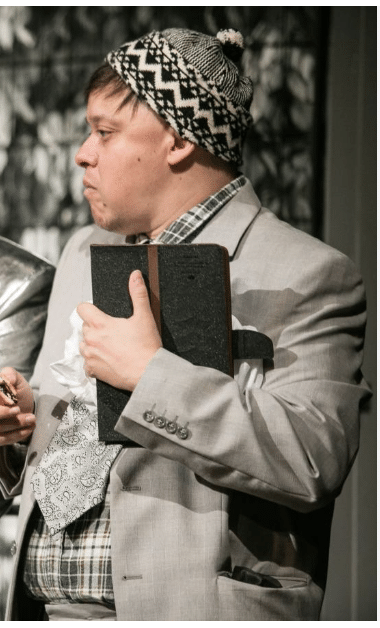
The problem of identity, whether individual or collective, is central to Havel. His critique of modern civilisation is inseparable from the search for identity and its loss. In The Garden Party, the first of his plays to win international renown, Havel places a paraphrase of Hamlet’s famous soliloquy on whether to be or not to be in the mouth of his protagonist, Hugo Pludek – a figure knowingly borrowed from the fairy tale of Honza, the simple Czech country lad who is loath to leave his native village, but who, after all manner of adventures and obstacles overcome, wins both the kingdom and the princess through his earthy charm and peasant common sense:
Petr Borovec as Hugo Pludek in The Garden Party, East Bohemian Theatre, Pardubice
photo Jan Faukner
“We are all a little bit what we were yesterday and a little bit what we are today; and a little bit we aren’t even that; all of us are always a little bit being and always a little bit not being; some of us more are and some of us more aren’t; some of us only are, some of us are only, and some of us only aren’t; so that none of us entirely is, and at the same time each of us entirely isn’t, and the only question is when it is better to be more and not-be less, and when, on the contrary, it is better to be less and not-be more; besides, whoever is too much may soon not be at all, and whoever knows how, in a given situation, to not-be to a certain degree may all the better be in another. I don’t know whether you want more to be or more not to be, or when you want to be and when not to be, but I want to be all the time, and that is why I must always a little bit not be – because a man who now and then a little bit isn’t is none the less for it!”
Although Hugo is not an altogether attractive character and his monologue bears the hallmarks of absurdist satire, its import is deadly serious. Unlike in the past, when a person’s identity was firmly bound to origin, place, soil and social station, the identity of modern man is fluid and changeable. It moves between extremes, from amorphous absence to assertive proclamation. We do not find our identity as something given; we seek it and discover it through what we do.
III.
Havel applied his conception of identity in his first public polemic with Milan Kundera – the debate on “the Czech destiny” conducted in the pages of Listy over the smouldering ruins of the Prague Spring at the end of 1968. Whereas Kundera regarded the programme of “socialism with a human face” as a pioneering, epoch-making idea, thanks to which “the Czechs and Slovaks, for the first time since the end of the Middle Ages, once again stood at the centre of world history”, Havel was far more sceptical of a programme whose aims were broad freedom of speech, limited political pluralism and an embryonic market economy. In his eyes the comrades were making a rather half-hearted attempt to establish a state of affairs that was taken for granted in the western half of the continent and in North America – and even this timid attempt had not withstood the tracks of Soviet tanks. “For whenever a Czech patriot lacks the courage… to look the cruel but open present in the face, to admit all its problematic aspects and to draw the appropriate conclusions ruthlessly, even if they must be turned against his own ranks, he turns to a better but already closed past, when everyone was united…” For Havel, the supposed national unity under the banner of socialism with a human face was a mere illusion. To defend one’s convictions meant nothing without the ability “to demonstrate one’s stance through concrete and dangerous action”. Patriotism without the resolve to act for one’s country is a form of folklore – as pretty and colourful as a folk costume, but in essence an end in itself. Havel fully committed himself to the defence of Czech identity only after 21 August 1968, through his active part in the clandestine anti-occupation broadcasts of Czechoslovak Radio, for which (among other things) the regime rewarded him with twenty years of persecution, surveillance, imprisonment and isolation. Kundera chose emigration.
IV.
A clarification, and a digression, are in order here. As with many of his generation, Havel’s Czech identity was interwoven with a Czechoslovak one. Havel did not subscribe to the rather unrealistic doctrine of “Czechoslovakism” – in his thinking and his speeches alike he recognised and respected the existence of two distinct nations (ethnos) – but he did share Masaryk’s idea of a Czechoslovak political nation (polis).
Havel is sometimes criticised for having underestimated or neglected, as president, Slovak national aspirations, and thereby having unwittingly contributed to the break-up of the Czechoslovak federation at the end of 1992. This criticism, which rests essentially on the single reproach that he failed to visit Slovakia immediately after his election (in fact he had already gone there as a presidential candidate, a week before he was elected), is unfounded. In his memorable New Year’s address of 1 January 1990, Havel named as his most important aim, second only to organising free elections, “to make sure that we enter these elections as two truly self-governing nations, respecting each other’s interests, national identity, religious traditions and symbols, /…/ that all the interests of the Slovak nation are respected.” No other Czech politician set himself such an aim in that heady moment of broken taboos, toppled idols and boundless horizons.
A more serious incident, which arose from Havel’s speech to the Federal Assembly on 23 January 1990 and heralded the so-called Hyphen War, was the product of a misunderstanding. It reflected not so much any failure on Havel’s part to grasp the importance of reawakened Slovak aspirations as one of his real weaknesses: a certain clumsiness in dealing with a parliament that had newly found its independence and its self-confidence. In his speech Havel was essentially proposing nothing more than dropping the word “Socialist” from the country’s name – without, however, properly discussing the legislative change with the key groups and deputies in both chambers. It seemed to him self-evident, and he anticipated no difficulties. In fact he opened a Pandora’s box of parliamentary creativity and let out the genie of national polarisation.
The “Czechoslovak” layer of Havel’s identity was the expression not of political calculation or abstract reasoning but of lived experience. Havel felt at ease in the company of Slovaks, and in this he was far from alone. Among his favourite “communal” pursuits were the summer camps with Czech and Slovak dissidents and friends at Brizgalky in the Kysuce region and at Hornosín in South Bohemia – in both cases among friends so thoroughly Czecho-Slovak that differences of national identity went practically unnoticed.
Even so, the Czech-Slovak case neatly illustrates Havel’s layered approach to identity, which he sometimes likened to the skins of an onion. An authentic personal identity founded on “living in truth” was his point of departure, but not an end in itself; on the contrary, it opened outwards into his “Czech”, “Czechoslovak” and “European” identities.
V.
The loss of Slovakia is one of the overlooked and unspoken – and for that very reason unhealed – traumas of our national history. The customary view of it as the best possible way out of a stalemate, one that ultimately benefited both partners, is politically sound but psychologically shallow. Whereas our Slovak neighbours saw the birth of the Slovak Republic – largely with good reason – as a positive gain, the attainment of statehood, the Czechs, especially those who had grown up in the common state, experienced the same separation as a loss. In the pause after the final chord of the Czech national anthem, many of us still subconsciously wait for it to go on. It is the musical equivalent of the phantom limb after an amputation.
Václav Havel, too, bore the separation as a traumatic loss. Although for a year and a half he did everything he could to prevent it – setting up a branch of the President’s Office in Bratislava and spending endless hours in fruitless talks with Slovak, Czech and federal leaders – he could not shake off a sense of shared responsibility and of having failed in his office. When, after the Slovak National Council adopted the act on the sovereignty of the Slovak Republic, the split became inevitable, he resigned.
And yet, as with the break-up of a couple, the break-up of a state can have positive as well as painful consequences. Our subjectively incomplete national identity may also keep us from giving full rein to nationalist passion and from defining ourselves against others with full patriotic smugness. There are few other rational explanations for the relative national moderation of the Czechs compared with the Poles, the Hungarians… and the Slovaks. Our most strident nationalists we have to import.
VI.
Paradoxical as it may seem, Havel’s national feeling was not weaker or more lukewarm than other people’s, but in many respects more purposeful and more ambitious. It showed in his own version of Czech “exceptionalism” – the conviction that precisely because of its complicated and painful experience of tyrannical and totalitarian regimes, the Czech nation had the opportunity, indeed the duty, to enrich the common well of world experience in an exceptional way. This resonated particularly strongly in Havel’s Europeanism. From the very first moment of post-November freedom he understood that we had no alternative but to seek a home, security and prosperity within the Western structures of European and Atlantic integration. As president he led his nation towards these goals, however distant and unattainable they may have seemed at the outset. Yet his was not the posture of a meek petitioner waiting outside the door to be let in, but the self-assured ambition of someone with something to offer. What opened our way into the North Atlantic Alliance was not, first and foremost, soaring speeches, nor Havel’s personal friendship with President Clinton, but a proven ability to contribute to European and Atlantic security – through the participation of Czechoslovak and Czech contingents in the first Gulf War and in the UNPROFOR, IFOR and SFOR operations in the former Yugoslavia – and to transform the Army of the Czech Republic in preparation for full NATO membership. Václav Havel was just as active towards the Conference on Security and Co-operation in Europe (CSCE) at the time when, in 1990, it was being transformed into the Organization for Security and Co-operation in Europe (OSCE). He saw Prague’s place not on Europe’s eastern fringe but at its very centre, and he worked actively for Prague to become the organisation’s seat. (In 1991 that role ultimately went to Vienna. Prague had to make do with the secretariat, and two years later even that moved to Vienna – where it has since contributed to the organisation’s growing irrelevance.) This was not a matter of local patriotism, but of the conviction that one of Europe’s modernised institutions ought to be based in one of its newly democratic countries and, among other things, to absorb the experience of totalitarianism as a memento. Sadly, in this endeavour Havel remained alone, both at home and in the Central European region.
Nor, towards the European Union, would Havel play the supplicant. Instead he stressed the particular significance of Central Europe as a region where, from time immemorial, not only the great European conflicts but also the great European ideas of reformation, emancipation and self-reflection had been born, begun and ended. From this reflection grew both Havel’s consistent support for the European project and his often sharp criticism of its technocratic, dirigiste and self-absorbed character. Similar thinking lay behind his role in initiating the Visegrád Group as a mechanism of regional cooperation. Whereas the support that today’s Czech (and not only Czech) politicians give the V4 often stems from the affinity they feel with the political crews currently in power in the group’s other countries, Havel’s thinking was rooted in centuries of shared history, fate and identity.
Havel’s idea of patriotism was a world away from nationalist navel-gazing, and all the more open to the role the Czechs could play on the European and world stage. He was bound to it, too, by the inexorable dictate of responsibility for the world around him. “Responsibility for the world is born in us when we look into the face of the other,” he said in his address to the French Senate in 1999, paraphrasing the French Jewish philosopher Emmanuel Levinas. A Czechia that shares responsibility for the world is decidedly a bigger country than a state preoccupied solely with its own needs, quarrels and anxieties.
It was during the bloody civil war in the former Yugoslavia that Havel applied his conviction most urgently – and therefore most controversially. As president of a newly created state that had escaped a similar fate thanks to a different history, a different geopolitical position and a measure of common sense among its citizens and politicians, he rightly sensed that the new Czech Republic could play a more significant international role only if it engaged with the burning problems of international politics and security in the name of values broader than narrow national interest.
In his speech at the unveiling of a monument to T. G. Masaryk in March 1993, Havel quoted the first Czechoslovak president: “We were buried when we ceased to live this great life.” And he left no one in any doubt as to what those words meant today: “If I were to apply this challenge to the present, I would understand it, for instance, as a call to recognise that the immeasurable suffering of our fellow human beings in nearby Bosnia and Herzegovina is of vital concern to us, that we must take an unequivocal stand on it and name the chief culprit, that we must accept our share of responsibility for peace and justice in Europe and, should all other solutions fail, support within our means even more forceful action by the international community. As those who once fell victim to the shameful Munich capitulation to an aggressor, we surely ought to know better than anyone that one must not retreat before evil, even when it is not being done directly to us. Our indifference to others can, after all, have only one possible consequence: the indifference of others to us.” There can be little doubt that, were Havel alive today, he would use similar or identical language about Russia’s aggression against Ukraine.
VII.
Havel’s “onion” conception of identity, personal and national alike, is modern in its inclusiveness. Its various components do not collide in irreconcilable conflict, nor do they pose an insoluble dilemma. At its core – more distinctly than in most people – lies personal identity, constantly tested and summoned to responsibility for the world and to living in truth. Around this layer lies his Czechness, which he unequivocally embraced at the critical moments of his own life and the nation’s: from August 1968, through the years of persecution and imprisonment and his leading role in the Velvet Revolution, to the last day of his presidency. European identity, defined by spiritual, cultural and political belonging, is the natural extension of Havel’s national identity. And the principle of shared responsibility for the world, grounded in a belief in universal human values and rights, completes it.
VIII.
The outer layers of Václav Havel’s identity drove his actions especially in the later part of his life, when from the presidential chair he could not only observe the course of events beyond the borders of the Czech Republic but also, to a greater or lesser degree, influence it. In moments of crisis, however, he always returned to its inner core.
In the remand cell where, in the second half of 1979, he awaited his inevitable conviction, Václav Havel had to face a Faustian temptation for the second time in three years. At the initiative of Joe Papp, the New York producer of his plays, and of his friend Miloš Forman, he received the offer of a year-long “theatre fellowship” in New York, delivered to him in prison in person by the head of the North America department of the Ministry of Foreign Affairs. The unspoken postscript to the invitation was that the ticket would be one-way. Set against the prospect of at least five years behind bars, it was of course a tempting offer, one that Havel discussed with Olga and turned over in his mind in his cell. In the end, though, true to his identity, he made an unequivocal choice. In Letter to Olga No. 18, written in prison, he says: “Can I last five years? I suppose so. I don’t have any other option anyway. Or perhaps I do – but I don’t know what would have to happen for me to choose it. On this I have dug my heels in. I’m a Czech bumpkin, and a Czech bumpkin I’ll stay.”
It is perhaps one of the least high-flown patriotic credos in modern history. Once again it rather calls to mind the iconic tale of the Czech Honza – but that only makes it all the more believable.
Kdo chce vést stát nebo město, měl by se opírat o data. Sociologové právě ta nabízejí a také interpretují. Ředitelka společnosti SC&C Jana Hamanová má na kontě řadu výzkumů a k nejzajímavějším patří ten, který zkoumal odolnost občanů třinácti zemí včetně České republiky.
My generation, Gen Z, is often called snowflakes. Unable to withstand anything. But is that true? Personally, I don’t think so. I see a number of implicit factors entering this discussion that people often overlook.
Low Frustration Tolerance
Dr. Radkin Honzák speaks well on this topic, pointing to the phenomenon of lower frustration tolerance among the younger generation. I agree with this claim. What does it actually mean? Frustration tolerance is the ability to withstand frustration without serious disruption to psychophysiological balance and without serious consequences for an individual’s mental health.
Lower frustration tolerance among part of Generation Z can manifest in several ways. One is quicker resignation when encountering obstacles, failure, or prolonged uncertainty. Another is a tendency to avoid unpleasant or stressful situations and to prefer solutions that offer immediate relief or quick gratification. It’s precisely because of these tendencies that Generation Z is often criticized as less resilient to frustration and discomfort.
Honzák points out that part of the problem may be related to the environment in which today’s young people grew up. Unlike previous generations, who were more accustomed to saving, fixing things, or delaying their needs, Generation Z is growing up in a world of instant availability and immediate gratification. Many things can be obtained almost instantly — often at the cost of debt. According to Honzák, this can lead to lower tolerance for waiting and scarcity, and generally a reduced ability to endure prolonged discomfort.
Specific Challenges and Intergenerational Distance
To understand Generation Z, we also need to look at the conditions in which it is growing up. Modern society places enormous pressure on young people to succeed in every aspect of life. They are held responsible for their appearance, their feelings, their choice of partner, their career, and much more. This constant pressure toward perfectionism creates an enormous psychological burden.
I identify with psychiatrist Petr Winkler’s view that Generation Z faces specific challenges. He also points to „mutual intergenerational misunderstanding.“ You encounter people running completely different „software“ than you. This naturally creates enormous pressure, especially on young people who are still forming their identity and need to understand and accept themselves.
Paradoxically, young adults can’t always rely on advice from those close to them. Winkler notes that „young people live in a world where the advice of their parents and grandparents is often somewhat useless, because they lived in a completely different world. The intergenerational distance caused by progress means not only that people are increasingly responsible for their own lives, but also that they have no guidance, nor anywhere to look for it.“
An Uncertain World, Full of Fast and Unexpected Change
So if someone claims Generation Z can’t withstand anything, it’s worth considering whether they’re judging young people by the standards of a world that no longer exists. Navigating today’s world takes considerable effort. It’s no wonder — society is increasingly turbulent and unstable, contributing to far greater uncertainty. This phenomenon can be explained by the VUCA model (Volatility, Uncertainty, Complexity, Ambiguity), which reflects the instability of today’s world.
Volatility: A rapidly changing world full of uncertainties and unexpected events can lead to feelings of stress and anxiety, weakening psychological resilience.
Uncertainty: A lack of predictability and a clear vision of the future can trigger feelings of hopelessness and loss of control, fueling depressive thoughts.
Complexity: The volume of information and stimuli we’re exposed to today can lead to overload and cognitive strain, reducing our ability to cope with problems.
Ambiguity: Many aspects of modern life are ambiguous and difficult to interpret, which can lead to confusion and helplessness, deepening depressive states.
This doesn’t mean, however, that all of Generation Z’s problems should be explained solely by the surrounding environment. From my perspective, the problem of lower frustration tolerance genuinely exists. Many young people are not used to enduring discomfort, delaying gratification, or facing obstacles over the long term. This can hold us back in many respects.
At the same time, it’s important to see both sides of the same coin. Lower frustration tolerance doesn’t arise in a vacuum. It forms in an environment that, on one hand, offers an unprecedented range of possibilities, but on the other, places enormous demands on young people. We didn’t get to choose the era we were born into. But we do get to decide how we respond to its challenges. This, I believe, is where psychological resilience comes into play.
The Path to Resilience: Learning to Tolerate Uncertainty, Not Avoid It
I like the perspective of Professor Pavel Kolář, whose book Strengthening Through Stress: The Path to Resilience highlights an often-overlooked fact: stress isn’t necessarily only harmful. If a person doesn’t avoid it and learns to work with it, it can become a source of growth and strength. As he writes: „Our body and mind hold enormous potential to make us not only strongly resilient, but also happy. Let’s use that potential and take responsibility for our health and quality of life into our own hands.“
Petr Winkler speaks similarly about resilience: „It’s important to realize that I actually build psychological resilience through my entire life.“ I consider this a key idea. Resilience isn’t a trait you’re born with. It’s an ability you gradually build through how you cope with uncertainty, overcome obstacles, and deal with failure.
This, I believe, is where Generation Z’s greatest challenge lies — not in being weaker than previous generations, but in having to learn to function in a world that is less predictable than ever before. All the more reason not to treat discomfort, uncertainty, or failure as things to be avoided at all costs. They are a natural part of life and, at the same time, one of the main sources of psychological resilience.
From my generation’s perspective, I think it’s important to accept that life’s challenges aren’t obstacles on the path to fulfillment — they’re part of it. As Professor Jiří Horáček often says, a precondition for human fulfillment is learning to tolerate uncertainty, not avoid it.
I think we need to learn to face life’s challenges and accept that not all hardships can be eliminated. The current generation, moreover, often faces intense pressure toward performance and perfection, amplified by social media and a culture of comparison.
All the more reason to recall the ideas of Viktor Frankl, who emphasizes that the key to overcoming suffering isn’t eliminating it, but finding meaning in what we experience. Though this path is difficult, it is precisely there, he argues, that human resilience is born.
I don’t think Generation Z is a generation of „snowflakes.“ It’s a generation growing up in an environment of high uncertainty and performance pressure. But that’s not a reason for resignation — it’s a reason for consciously building resilience. Not because we’re weak, but because we live in a time that demands it.
A když se řekne typický Čech, co vás napadne? Podle průzkumu společnosti Solvo je to muž středního věku s pivním pupkem, málo se usmívá, ale z gauče rozumí sportu i politice.
V televizních novinách zazněla reportáž z našeho výzkumu: Česká identita. Typický Čech je podle průzkumu Solvo muž středního věku s pivním pupkem, který se moc neusmívá, ale rozumí sportu i politice. Češi jsou hrdí na svou kulturu, historii a sportovní úspěchy a rodinu považují za největší hodnotu. Mají rádi psy, pivo, zahrádky, houbaření a chaty. Často nosí pohodlné oblečení, jako jsou sandály sponožkami, a znají filmové hlášky.
Jak vypadá typický Čech? Má rád svoji zemi a umí dodržovat pravidla? Nový výzkum Solvo Institutu ukazuje, že je to spíš introvert a praktický člověk, který nevyčnívá, miluje humor, nedůvěřuje autoritám – a zároveň je loajální, když jde do tuhého. Výsledky kombinují vzorek více než tisíce lidí a také fokusní skupiny napříč Českem.