
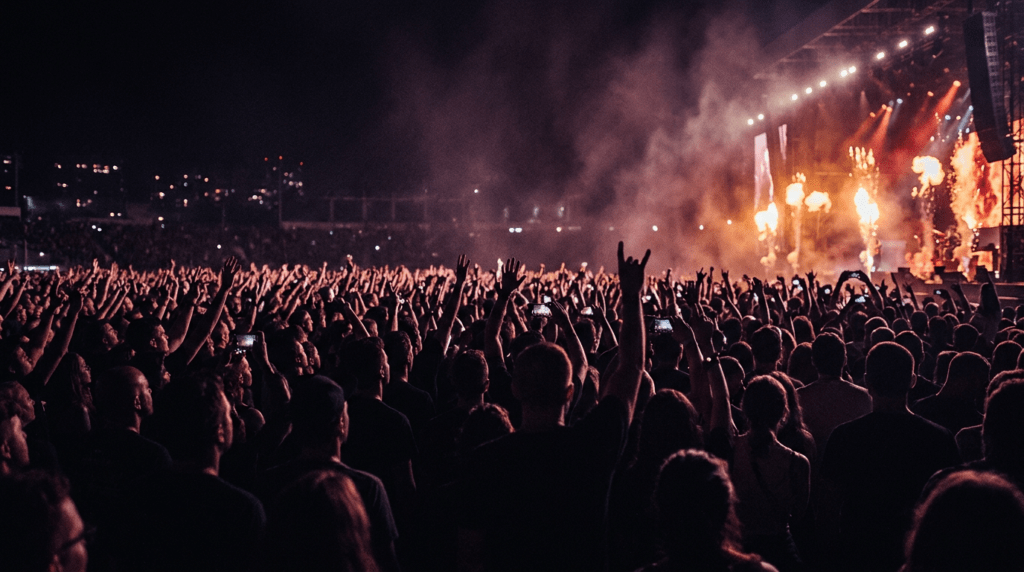
The autumn of 2008 did not look like a natural time for a rock party. Banks were collapsing one after another, stock markets were plunging and the world began to use words that had previously belonged mainly in history textbooks: recession, collapse, systemic risk. People were losing their jobs, companies were freezing investments and economists were explaining that we were entering the biggest financial shock since the 1930s. And precisely at that moment, stadiums around the world began to sell out. AC/DC took to the stage, and tens of thousands of people were singing along to choruses they had known by heart for thirty years.
The tour for the album Black Ice became one of the most successful in the history of the music industry – paradoxically in the middle of the global financial crisis of 2008. Economic logic would suggest the opposite. In times of uncertainty, people are supposed to save, cut back on entertainment and keep a low profile. But human behavior in crises is not driven by economics alone. It is driven by psychology.
When the world becomes unpredictable, people do not automatically start living more frugally. They start looking for certainty.
And culture is one of the quickest ways to find it.
AC/DC are an almost perfect symbol for such a time. Their music does not change, it does not surprise, it does not try to reflect the complexity of the world. It is direct, loud and physical. At a moment when abstract systems are collapsing – financial markets, mortgage models, the global economy – it offers something almost primitively stable: a rhythm that does not change. People were not just buying a concert. They were buying the feeling that at least something remained the same.
Crisis, paradoxically, increases the need for shared experience. Fear is an individual emotion, but relief is collective. A crowd at a concert, a packed stadium or a sold‑out cinema work as modern rituals. For a few hours, the sense of isolation disappears. A person stops being an individual watching the news and becomes part of something larger.
History shows that this is not an exception, but a rule. During the Great Depression of the 1930s, Americans did not stop going to the movies – quite the opposite. Hollywood musicals were booming. Audiences watched glittering dance scenes that had nothing to do with the reality of unemployment, and that was precisely why they worked. After the terrorist attacks of 11 September 2001, attendance at sports events increased dramatically; society was searching for moments of collective breathing. And during the Covid pandemic, people around the world massively watched old TV series and listened to the music of their youth instead of new releases.
In good times we want experiments. In times of uncertainty we want familiar things.
Psychologists sometimes call this a return to cognitive simplicity. A brain overwhelmed by uncertainty rejects complexity. It seeks clear emotions, predictable structures and stories without ambivalence. That is why crises often bring not only the comeback of musical legends, but also the rising popularity of retro aesthetics, remakes and cultural icons of the past. It is not nostalgia in the sentimental sense. It is a stabilizing mechanism.
We can see this pattern again today. Europe lives in the shadow of war, the world follows conflicts from Ukraine to the Middle East, and the public sphere is flooded with news about geopolitical tensions, technological shifts and economic uncertainty. People feel threatened, even when their everyday lives often remain relatively stable. And it is precisely in such moments that the demand for simple, intense experiences grows.
Sold‑out concerts of 1990s bands, the return of major tours, record festival attendance or the huge popularity of mass sporting events are not an escape from reality. They are a response to it. Society is regulating its emotions in much the same way that an individual looks for calming routines under stress.
Interestingly, in a crisis people are not primarily spending on luxury in the traditional sense. It is not mainly about status. It is about intensity. About an experience that is shared, understandable and immediate. Economists sometimes talk about the “lipstick effect” – a phenomenon where, during a recession, sales of small treats rise because big dreams have been put on hold. Concerts, festivals and shared events work in a similar way: they are an attainable moment of control over chaos.
Perhaps that is why, in uncertain times, it is not intellectual music or complex art that resonates the loudest, but rhythms the body understands before the mind does. When the world feels too complicated, people are not looking for explanations. They are looking for synchronization – a moment when thousands of people clap in the same tempo and briefly share the same emotion.
The economic charts are pointing down, but the volume of the speakers is going up.
And that is no paradox. It is one of the oldest human responses to uncertainty: when we are afraid, we gather together and make noise, to remind ourselves that we are not alone in it.
Napsat komentář