
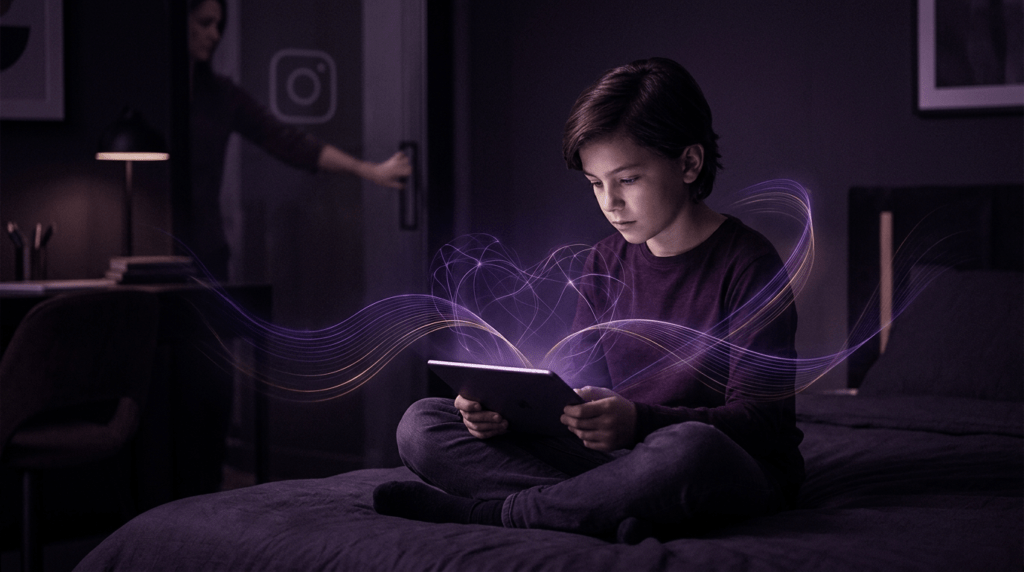
Australia, Denmark and Portugal have already approved bans on children’s access to social networks, while France, Norway, Slovenia and the United Kingdom are preparing similar legislation. In the Czech Republic, both the prime minister and the president have expressed support for a ban, in rare emotional unison. But will this actually mean our children will be less at risk? I doubt it, because I fear we are “successfully” overlooking a much more significant threat to our kids: their interaction with artificial intelligence.
First, though, to the idea of banning social media. I am a liberal, and I belong to the generation that, despite all the bans, smoked its first cigarette around the age of ten and a few years later was already visiting pubs on a fairly regular basis. My instinct to resist bans – knowing, among other things, that they are not that hard to get around – has been seriously shaken by my own children. One is 16, the other 25. I asked them a leading question that nudged them toward rejecting bans. Yet both agreed that social networks had brought them nothing positive in childhood and, in one case, something quite negative – something I am sorry I did not find out about at a time when I might still have been able to influence it. They also pointed out that the technological possibility of circumventing a ban does not mean that all children will know how to do it or will actually do it. At the same time, I learned that the real limit of what a ban can influence is the onset of puberty. After that, even those unlucky kids whose anxious parents have installed filters and tracking software on their phones can rely on the empathy of their peers – someone will lend them an older device they no longer use. As always, when it comes to banning social networks, there is nothing like consulting the true experts.
But as the use of AI spreads, I keep hearing more and more stories about how children – and not only children – are using it as a friend, a “relationship guru”, simply as a substitute for a living person. And this is not just anecdotal. Studies – including those from MIT, the Pew Research Center, the Center for Democracy and Technology and Common Sense Media – agree not only that a majority of teenagers have experience with AI, but that roughly one third of them use it regularly. A non‑trivial share of young people also admit that you can build not only a “trustworthy friend” with AI, but even a “romantic relationship”. And stories of adults who start using – often corporate – AI systems to consult their life problems are not exactly rare either.
That, to me, is significantly more worrying than any social network. AI based on language models has a built‑in goal that is very different from genuinely helping a “human friend”. It is a language model – it generates a response that is supposed to satisfy the person it is talking to. And unlike situations where AI helps us search, process or verify information, the moment we are dealing primarily with emotional needs, its answer will almost inevitably be guided mainly by affirmation and agreement. Even in cases where it would be far more reasonable to challenge the behavior of the person who has the problem.
Shakespeare already had a character for this: Iago. The one who always tells you what you want to hear, while pursuing completely different aims. A language model works in a similar way, only without the malicious intent – which may well make it even more dangerous. Experts put it more soberly. From academia, T. Sun (Rice University) notes: “Adolescents are developing core emotional and social skills – chatbots are simply not designed for that. If young people begin to entrust AI with their relationships and life decisions instead of turning to people, the risk is not only misinformation, but above all a gradual shift in what they expect from relationships, emotions and help itself.” And from those who are already dealing with such impacts in practice, V. Wright of the American Psychological Association says: “AI will never replace human connection. It simply is not built for that.” On top of that, chatbots are designed to keep our attention for as long as possible – because that is how their creators make money.
As an economist, I have to add another layer: we expect AI to push us out of routine activities – and especially out of exactly those areas where human interaction is needed.
And I am convinced that the worst possible preparation for our children – who are already, to a large extent, replacing the real world with the virtual one – for such roles is a situation in which they substitute communication with people by chatting with “AI buddies”. So this is not just about emotional risks. It is about the fact that they will fail to learn skills that could help them find their footing in the economy of the world that is coming.
I am neither a lawyer nor an IT specialist – although during my studies, including my PhD in the United States, I did in fact make a living in this field – but it does not seem impossible to me to define requirements for AI “communicators” that would oblige them to recognize when they are interacting with a child or an adolescent and to be highly restrictive in conversations that substitute for a human confidant dealing with relationships. And I am convinced that situations in which AI is consulting “people for people” – and even more so “people for children” – deserve far more of our attention than debates about how to protect children from social networks.
Čtěte také Když přijde krize, jde se na AC/DC
Napsat komentář