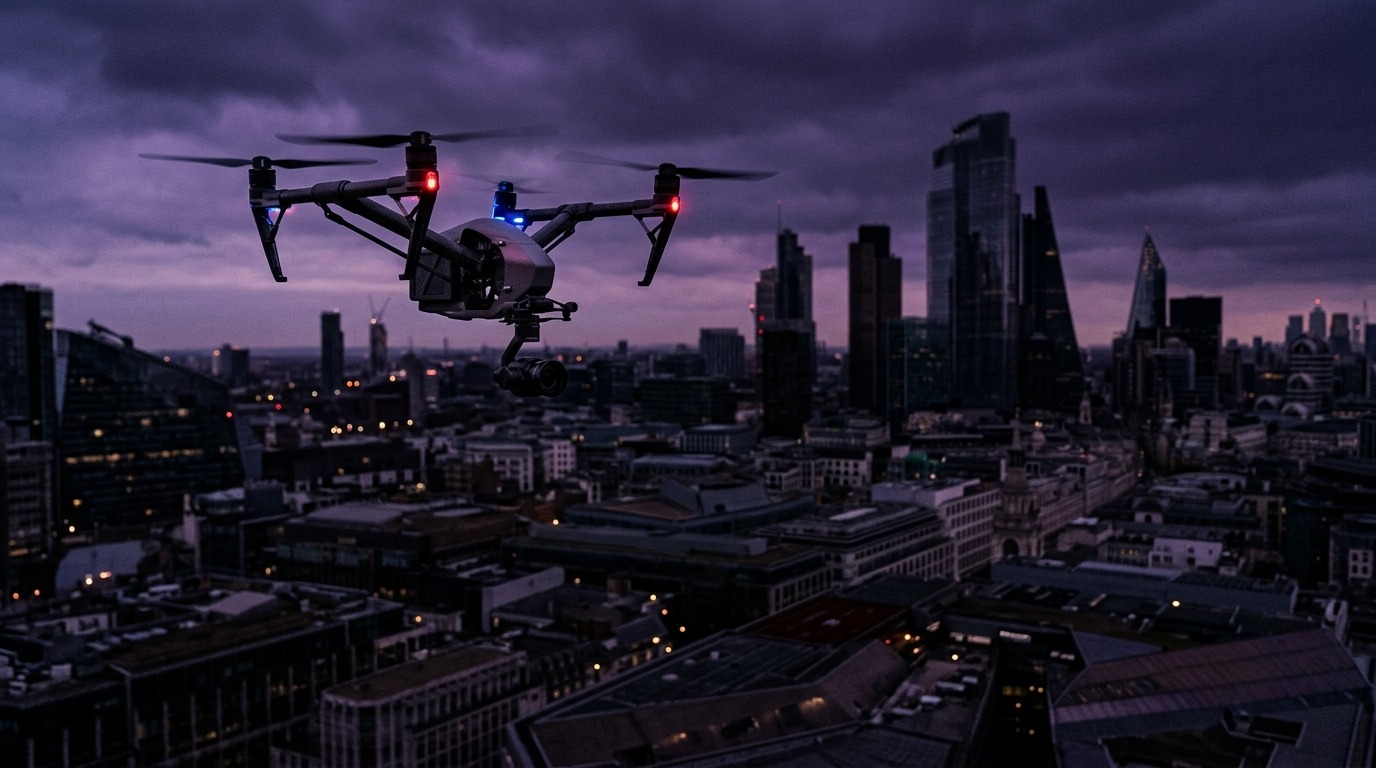

When I watched the Gulf War in 1991, I was genuinely captivated. Footage of nighttime Baghdad, its sky lit up by dozens of flashes. Nowhere any blood, mud, or trenches. Back then it was called „the war broadcast live.“ Something fundamentally changed at that moment, and all of us who were glued to CNN at the time noticed it.
Today it’s exactly the opposite. Current technology has brought war within a few meters‘ distance. Right next to the human body. But this new image isn’t in more perfect resolution. It’s shaky, grainy, (actually cheap), and brutally intimate.
Drone warfare. Suddenly it’s here. Science fiction. Ukrainians have even told the media that they tested an experimental program called Terminator, in which drones select their own targets — without humans controlling them. (For those of you who haven’t seen James Cameron’s famous film Terminator, I should note that it’s precisely in that film that autonomous war machines decide, on the command of artificial intelligence, to wipe out humanity.)
In our current reality, we haven’t really noticed this enormous shift. It’s strange how long a society can overlook a fundamental change when it doesn’t arrive as one big event but instead accumulates in small doses.
A post-apocalyptic way of waging war
Something has been born in Ukraine that can no longer be described merely as another development in military technology. There, drones have become the environment that creates the battlefield itself. They are eyes, nervous system, and weapon all at once. They track movement, direct fire, carry explosives, and change the very logic of movement across the battlefield. Reports and expert accounts speak of a space where almost everything is visible and almost every movement can be punished within seconds. That’s why soldiers no longer hide only in trenches, but in pipes, under roads, in cellars, in improvised shelters — because open terrain has turned into a corridor to death.
The front is no longer a „line“ — it’s three-dimensional
And this is precisely where the real break lies. In the past, it was possible to speak of the front as a line. Today, however, the „front“ is also vertical. Death no longer comes only from the front or the rear, but from above. Quietly, cheaply, and repeatedly. A soldier is no longer fighting just another soldier, but a system of sensors, operators, improvised workshops, and consumer-grade technology that can be sent into the air by the thousands. Classic superiority in tanks or artillery hasn’t disappeared, but it has stopped being sufficient on its own.
Perhaps even more important than the military dimension is the social one. Drone warfare is changing not just the way killing happens, but the way war is observed. The Gulf War was a televised war. The public received a carefully „curated“ image of technological dominance, in which the enemy was distant and pixelated. Today’s war spreads through Telegram, X, YouTube, and closed channels, in the form of short videos that have the aesthetics of video games but the consequences of real death. The public thus becomes a peculiar kind of witness: it sees more than ever before, but understands less. It sees the detail but loses the whole picture. And because the footage is endless, even horror becomes normalized.
War as a series of clips
And this has serious consequences for a society growing accustomed to a new ratio between proximity and numbness. Just a few years ago, footage of a direct hit on a person was something extraordinary. Today the audience often just scrolls down. Technologies that were supposed to increase precision are simultaneously creating a new kind of psychological accessibility of violence. War stops being a distant geopolitical news item and becomes an endless stream of short clips. Not everyone watches them, but everyone now lives in a world shaped by them: a politics of fear, compassion fatigue, a feeling that nothing is stable and that safety is only a temporary technical advantage.
Into this world steps Iran as one of the actors who have understood the logic of the new warfare very well. Iranian drones have become a significant part of Russian attacks on Ukraine and, at the same time, a symbol of the broader transformation of armed conflicts in the Middle East. Their power lies not just in technical specifications, but in the economics of the whole matter. Instead of expensive aircraft and complex platforms, relatively cheap means take over — ones that can be manufactured in large series, are hard to detect, and can be deployed with strong psychological effect against cities and infrastructure.
What kind of war should Czechs fear?
This is why Czechs, too, should stop imagining a future attack merely as a scene from a historical war film or as a massive missile strike. Far more plausible is the disruption of everyday life. A few drones over an industrial zone. An attack on an energy hub. Transport outages. Disruption of an airport or a railway corridor. An alert around a hospital, a fuel depot, or a data center. Such an attack doesn’t need the parameters of total war to paralyze a country’s psyche. It’s enough that it shatters the sense of predictability. That’s precisely what’s so unsettling about drones: they are not just a weapon of destruction, but also a tool of cheap destabilization.
How to picture this concretely? Not as a Hollywood explosion, but as a series of smaller strikes, after which things a citizen takes for granted simply stop working. Part of the distribution grid is down for a few hours. Traffic at a logistics hub comes to a halt. Police cordon off the area around critical infrastructure. An unidentified object circles over the city, and no one knows for sure whether it’s carrying a camera, a jammer, or an explosive. In such a moment, it’s not just damage that arises. Distrust arises. And in a modern society, distrust is almost as effective as a direct hit.
The greatest experience with drones: Ukraine and Israel
The question of protection is therefore not a technical footnote for the military, but a public issue. Ukraine’s experience shows that defense against drones cannot rely on a single miracle system. What works is multi-layered protection: early detection, electronic jamming, physical destruction of drones, protection of key routes, and adaptation of both movement and infrastructure. Ukraine has built layered defense models while also increasing production of interceptors — drones designed to destroy other drones. Alongside this, it protects roads and logistics routes, because even the survival of transport is today a combat capability.
Israel, in turn, demonstrates another side of the same equation: the ability to combine sensors, air defense, industry, and rapid testing of new countermeasures. In 2026, Israel’s Ministry of Defense tested approximately twenty advanced anti-drone technologies, and the country is also accelerating the development of laser systems meant to make defense against mass attacks cheaper. Following experiences with drone attacks, Israeli know-how is becoming sought after in Europe as well.
So it’s time to start doing something. And in an accelerated mode. Not as usual
Napsat komentář