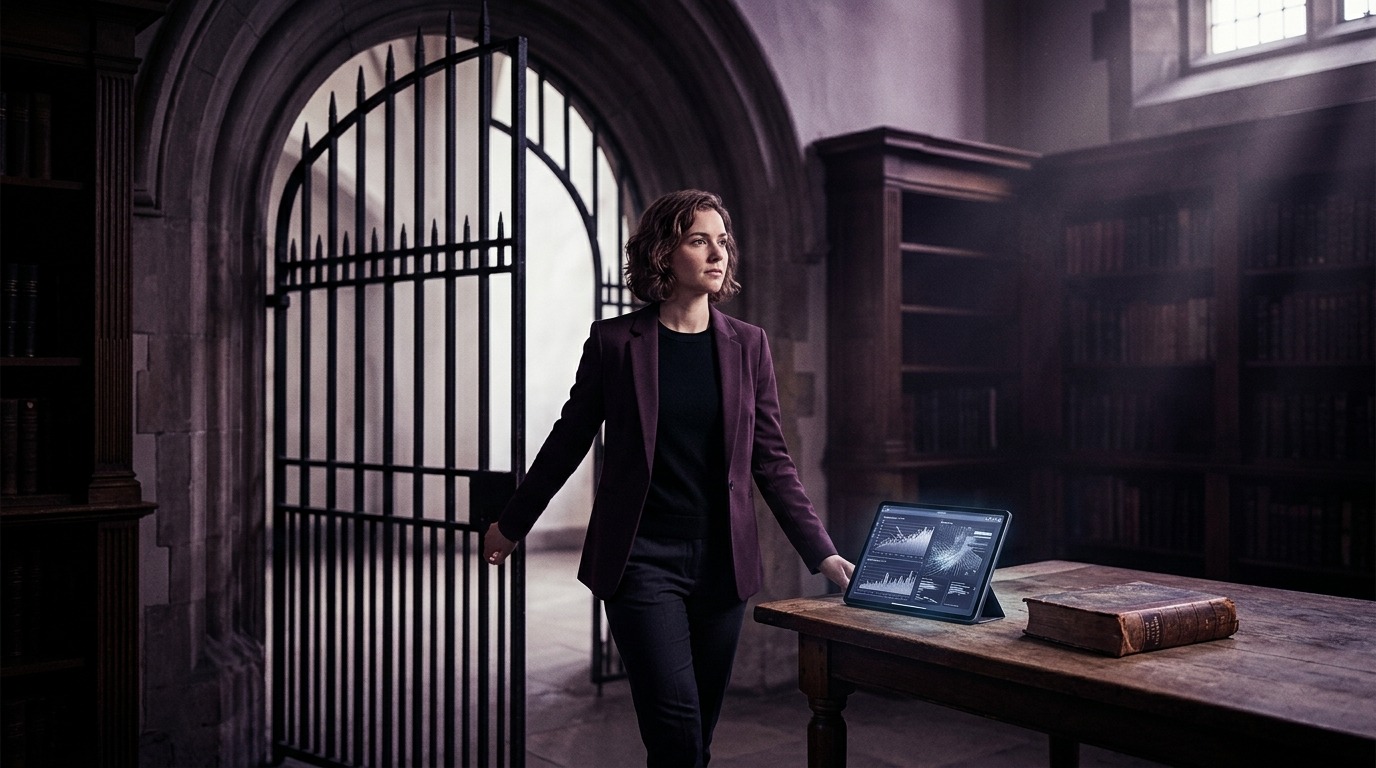
A few decades ago, university was almost the only legitimate route to advanced knowledge. If you wanted to read specialist books, meet leading minds in your field, or attend serious lectures, you had to get inside: through the gates of a faculty building, into a library, into a lecture hall—or at least into the orbit of someone who had already made it there.
Today, those gates are wide open. Lectures from Oxford are online. So are courses from Harvard. Academic papers can be found in minutes, and anyone can learn programming, video editing, data analysis, or the basics of economics from a laptop at the kitchen table. Sometimes for free; sometimes for the price of a few coffees a month.
That does not mean the internet has replaced education. The internet is also where, in fifteen minutes, you can discover that the Moon is a hologram and that cinnamon can solve geopolitics. But it does mean that universities lost their monopoly on information a long time ago.
A few years ago, Elon Musk put it in his usual way: college, he argued, is not necessary for learning, because almost anything can be learned for free. Universities are mainly places for fun, networking, and training in how to meet obligations. It is a characteristically Musk-like observation—provocative, exaggerated, and not entirely fair. Still, it is useful. Not because Musk must be right, but because he identifies something the academic world is reluctant to acknowledge.
They No Longer Guard Information
University is no longer a temple of knowledge, reached by climbing a grand staircase and collecting several official stamps along the way. Knowledge is everywhere now. The challenge is not accessing it. The challenge is knowing what deserves attention, what is nonsense, what merely looks impressive, and what one has actually understood.
That is precisely where higher education can still make sense.
A good university should not be a warehouse of information. It should be an environment where people learn how to think: where they meet people who are smarter than they are, who hold opposing views, or who look at the same problem through an entirely different discipline. It is where students have to defend an argument, accept criticism, and discover that confidence without work tends not to last very long.
In that sense, university remains hard to replace. Not because of a PowerPoint presentation on macroeconomics—which can be watched at home at double speed—but because of the conversation after a lecture, the disagreement over a seminar paper, the people one meets in student housing, and the mistakes one can make in a relatively safe environment.
It is a kind of laboratory for adulthood. People arrive believing they understand how the world works and leave—ideally—with at least a suspicion that it may be more complicated than they thought.
The Problem Is Not the Degree
This does not mean degrees have lost their value. They have not. In medicine, law, architecture, and many technical fields, long-term and systematic education is not only useful but indispensable. Nobody wants to be operated on by someone who completed a weekend surgery course online.
But across a large part of the economy, a degree alone is no longer enough. Employers increasingly want to know what someone can actually do. What they have built. Which problem they have solved. How they managed a project. What they can show in a portfolio—and what the people who have worked with them have to say.
In marketing, event management, creative industries, technology, or sports business, this is already obvious. A résumé may list an excellent university, but if it is not backed by results, practical experience, and the ability to deliver, the magic of the degree fades quickly.
Universities should therefore not compete with the internet on who can transmit information faster. That contest is already lost. They should focus on what the internet cannot do nearly as well: provide guidance, feedback, community, demanding standards, and opportunities to turn knowledge into real work.
One Degree Is Not Enough for a Lifetime
There is another problem. Education systems often still operate on the assumption that a person studies a subject at twenty-two, packs it into a suitcase, and then carries it through the rest of life.
But working life no longer looks like that. Technologies evolve, industries merge, new professions emerge and old ones disappear. Someone may begin in communications, move into data a few years later, then manage a team, and a decade after that discover they need to understand AI, regulation, or energy. Meanwhile, life happens: family, relocation, caring for relatives, shifting priorities.
It makes little sense, then, to treat education as a one-time chapter that ends with graduation. A more sensible approach is to build an educational profile over time. Alongside traditional degree programmes, there should be room for shorter courses, professional certificates, microcredentials, and specialised modules.
Microcredentials are not a magic solution. Without quality and a real connection to practice, they can easily become a collection of digital badges that nobody takes seriously. But when designed well, they allow people to develop a specific skill without having to disappear from work and everyday life for three years.
This is where the Czech debate should also be heading. In its “Ten Principles,” the Solvo Institute argues for more flexible higher education, microcredentials, and lifelong learning. This is not an attempt to abolish universities. It is an attempt to stop treating them as the only places where people are allowed to learn.
Two Speeds
A future in which universities no longer hold a monopoly will not automatically be fairer. Quite the opposite. Those with time, money, language skills, networks, and the ability to navigate independently can gain a great deal from open education. Those without these advantages may simply be left behind.
We cannot merely tell people: “Everything is online, so try harder.” We need accessible retraining, sensible career guidance, and pathways that make sense even for someone whose parents did not attend university or who does not have free evenings to study.
We also need to be honest: the labour market will probably operate at two speeds. In some fields, a university degree will remain essential. In others, a combination of experience, continuing education, projects, and verifiable skills will matter more and more. The goal is not to devalue one path in favour of another. It is to stop pretending that there is only one path.
Universities are not losing their purpose. They are only losing the comfortable assumption that their purpose is self-evident.
And perhaps that is good news. They no longer need to guard the gate to knowledge. They can do something far more useful: help people turn an excess of information into judgment, skill, and the ability to navigate a rapidly changing world.
Would you like the English version to sound more distinctly British, more American, or more policy-oriented for an international think-tank audience?
Napsat komentář